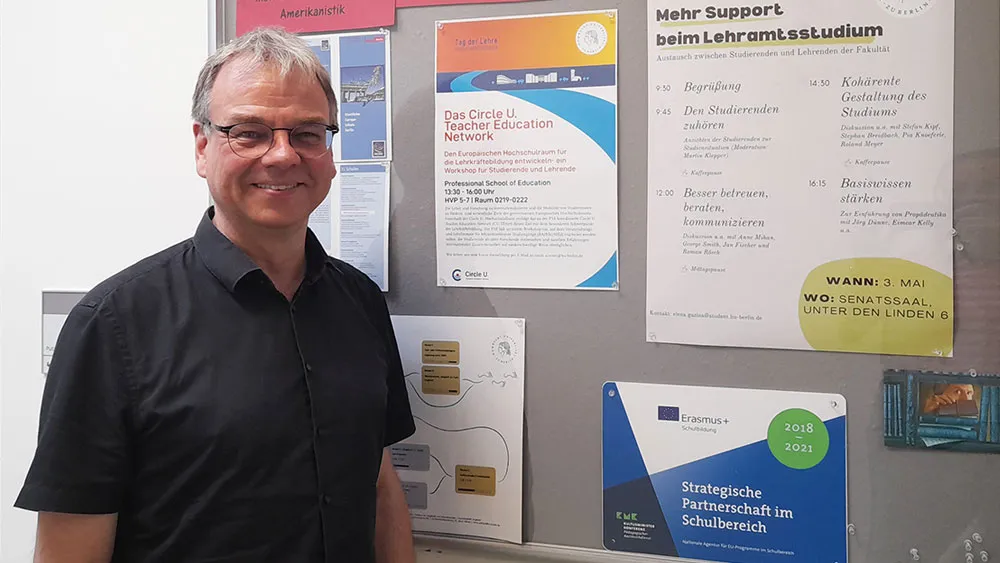
Seven of the nine Circle U. universities train future school teachers. In the alliance's 2023 seed funding call, a group of six researchers from Berlin, Belgrade, London, Louvain, Oslo and Vienna secured € 10.000 to fund the Teacher Education Network or TENet. They are determined to develop viable structures and formats that allow teacher students high-quality international exposure while engaging with ‘real’ research related to their professional field. We spoke to Stephan Breidbach, the Director of Humboldt's Professional School of Education and TENet lead to find out more.
I also believe that if we as a society want to develop and sustain European values, it will be vital for teachers to be familiar with other school systems and to meet colleagues who work within these systems.
Professor Breidbach, your project aims at internationalizing teacher education. Why do you think we need more of that?
Teachers are trained for specific regional or national contexts, at most. In our case at Humboldt, we look at the Berlin school sector. Clearly, this is an important but also a very narrow perspective. Most of our teacher students have gone to school in Germany and never got to know other countries' schooling systems. Understanding the unique contexts of someone teaching History in Serbia or English in Louvain, for example, allows future teachers to broaden their horizons and to see their own profession from a new angle. Teachers are educators wherever they work, yet, while some challenges may be similar, others can be very different from what students experience in their own countries. I also believe that if we as a society want to develop and sustain European values, it will be vital for teachers to be familiar with other school systems and to meet colleagues who work within these systems. This facet of professional learning should start in the teaching degree programmes at university.
With TENet you are looking to get Circle U. students to work on and exchange about their own research projects. Why the emphasis on the research dimension?
Doing research in the own professional field is a strong driver in professional learning. It helps to challenge traditional beliefs about teaching and school, offer new perspectives and, very often, has a motivating effect to learn more. All Circle U. TENet partners already have elements of research-based learning in our teacher education curricula. Here at Humboldt, for example, doing a field-research project is part of every future teacher's practical semester – no matter the subject and school type. They choose their own topic, which can be, for example, about classroom interaction, effects of specific teaching strategies, materials development, teacher responses to diversity among learners and inclusion, or anything else that's of interest in the school setting.
What could this internationalized research-based learning look like in practice? How would this be different from the already existing offers for exchange semesters?
For pragmatic reasons, we are mostly looking at short term mobility. Many students have part-time jobs, many of them already at schools teaching. This means that they cannot leave Berlin for a longer period. To allow them still to include international experience during their studies, we are imagining coordinated teaching formats with virtual and short in-person mobility phases. This could be a joint kick-off and closing event for a course which is taught at two or more Circle U. universities, or a joint symposium at the end of a research-based course. There can also be blocked seminars at the different universities for a week each. Ideally, we will design courses that will allow students to choose study elements at the other universities which then count towards their degree. In the long run, it would be very tempting to think about a joint European Degree for future school teachers offered by Circle U. This would be fully in line with the trajectory and logic of building a European Education Area.
Teacher education to me is the obvious example where our universities create direct social impact and make a big contribution to paying society back some of its investments in Higher Education.
You receive € 10.000 funding from Circle U. How was the application process?
It wasn't complicated at all: The group of colleagues that has now become the TENet Group started to work together a long time before the call for seed funding applications was launched. Our aim was to give more visibility to teacher education within our universities and how it is based on and related to hands-on research as an important part in our teacher education curricula. Also, we felt that our teacher education programmes hold specific limitations for international student mobility but also enormous potential for international collaboration and exchange. So, already knowing what we wanted to achieve helped us to write the application a lot. Our group met in Berlin last year to put together a proposal explaining how our goals are in line with the goals of our European University Alliance – which include the fostering of democratic citizenship and participation as well as innovation and societal impact. Teacher education to me is the obvious example where our universities create direct social impact and make a big contribution to paying society back some of its investments in Higher Education. Our project, I believe, is a perfect fit and we are really happy to receive the money: It allows us to spend this year on a lot of groundwork which we hope to further develop beyond the funding phase.
How are you spending the grant money?
The money allows us mainly to involve students in our project work. They are conducting and analysing interviews with teacher education students at all of our universities to find out what experiences they have with co-researching and other forms of research. As course developers, we want to learn out about students’ attitudes towards research as part of teacher education and about their opportunities for international mobility. The students, who are our co-researchers in the current seed funding project, join our project meetings and attended the CU.til week in Louvain in September to take stock and start developing courses. To present the project outcomes, we will are planning to hold an Open Conversation event in Berlin early in 2025.
In a broader perspective, I hope that the Circle U. universities' teacher education centres and faculties will come together to build a collaboration platform across Circle U.
What are your hopes for the project's future – and for teacher education within Circle U. more broadly?
The results of our work will soon be visible through offers we make on Circle U.'s Open Campus platform. I also hope that more colleagues who share our aims to internationalise teacher education across Circle U. will join the TENet group.
In a broader perspective, I hope that the Circle U. universities' teacher education centres and faculties will come together to build a collaboration platform across Circle U. Teacher education is a societal and political commitment and, therefore, at the heart of what our universities do. Through teacher education, Circle U. can reach out to a very large proportion of our students: roughly a quarter of Humboldt students are studying to become teachers. Our efforts are vital to securing the sustainable development goal of quality education for future generations.