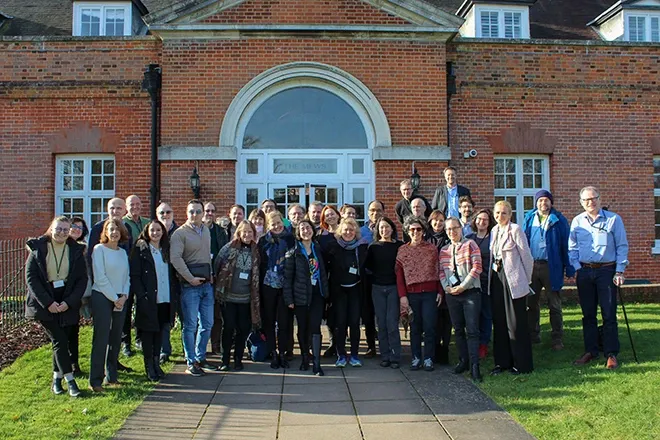
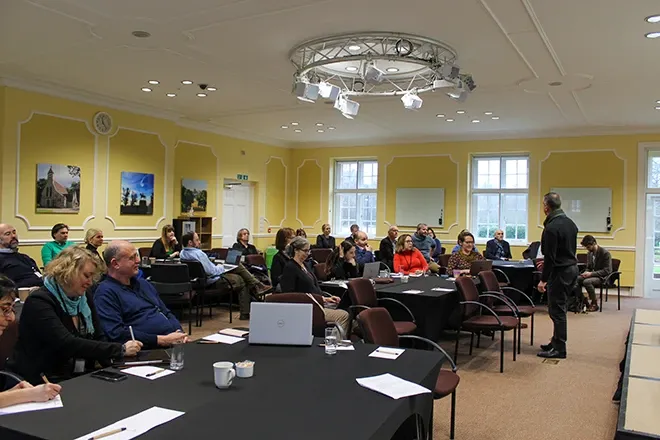
The retreat was a valuable opportunity for Academic Chairs to meet in-person and helped to build a stronger sense of community and common purpose. In a series of sessions led by Dr Vinicius de Carvalho, Reader in Brazilian and Latin American Studies and Vice-Dean (International) in the Faculty of Social Science & Public Policy at King’s College London, Circle U. Academic Chairs and Coordinators discussed and proposed principles for interdisciplinarity, pedagogy and engagement with external stakeholders in Circle U.
Interdisciplinarity for the Circle U. Chair Academy
As a key principle for the Circle U. alliance, interdisciplinarity was addressed first. Participants agreed that for the future of the alliance, interdisciplinary initiatives should be valued, facilitated and at the centre of the alliance’s initiatives. The participants also discussed the need for more support for publications that are interdisciplinary, and how to develop pedagogies that address programmes with students from diverse backgrounds and with different sets of prior knowledge. Chairs and Coordinators also recommended a bottom-up approach, where students and educators are prepared for and supported to work in interdisciplinary spaces but noted that institutional encouragement and support from the top is crucial.
A Circle U. pedagogy
Three topics were at the centre of the discussions on pedagogy within Circle U.: online education, participatory pedagogy and Equality, Diversity & Inclusion (EDI).
The outcomes of this discussion included that online education should be designed for an online classroom, rather than being online by necessity (as was the case during the COVID-19 pandemic). By co-creating innovative and interactive learning with students, incorporating facilitators from industry and around the world, and encouraging students to bring their own cultural background to an international classroom, Circle U. could capitalise on the benefits of a remote format.
Chairs and Coordinators also reflected that participatory, or student-driven, pedagogy works best in small, motivated groups, and that problem-based learning can be particularly effective in this context. The importance of considering the different languages, cultures and disciplines coming to a Circle U. classroom will continue to be a key aspect to consider in future.
Finally, the need for a common language about EDI across our nine institutions and countries was also highlighted. In future, it will be important to understand how the different universities address EDI in policy and practice and consider how to be more inclusive when we recruit staff and students for Circle U. activities.
Beyond the Circle
Academic Chairs and Coordinators went on to explore their experiences of working with external stakeholders and how we can strengthen these relationships within Circle U. Amongst the recommendations was forming equitable partnerships, where the benefits and expectations are clearly defined for both sides, and developing a clearly defined and recognisable public image for Circle U.
The potential to add a Circle U. dimension to existing partnerships was also discussed, as well as building relationships with university spin-offs and alumni programmes. Circle U. could also be an opportunity for greater collaboration with the Global South, and to benefit the wider public, for example through open lectures and innovative programme formats that facilitate inclusion.
What’s next for the Chair Academy?
The outcomes of the retreat will be brought together as a set of principles and proposals designed to contribute to the planning of the next phase of Circle U. The Chair Academy will continue to be a crucial aspect of the alliance, as a forum for open discussions on the education and research activities that will be developed in future.