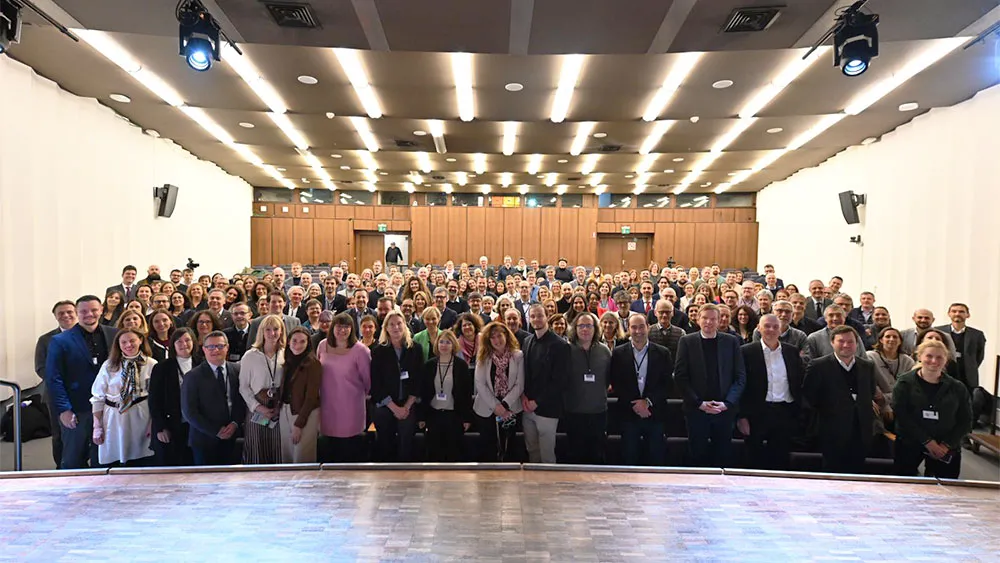
On 30 November a delegation of Circle U. colleagues attended the first Cross-Alliances Forum dedicated to the topic of science with and for society in European Universities Alliances at Université libre de Bruxelles.
The Forum gave representatives of the various alliances the opportunity to gather together with stakeholders and policymakers from the European Commission and other university networks and exchange on the current and future challenges related to the research and innovation dimension of alliances. Circle U. was part of the organising committee together with CHARM-EU, FIT FORTHEM, EU-CONEXUS, CIVICA, Arqus European University Alliance, EUTOPIA, 4EU+ Alliance, ERUA - European Reform University Alliance, EPICUR University Alliance, CIVIS - Europe's Civic University Alliance and Una Europa.
Policy background
Events of this kind are also a way to provide collective feedback to the European Commission. This is of utmost important for the alliances that are aiming to develop and implement the scientific agenda. Indeed, if alliances have been supported by a top-up from Horizon 2020 programme, this funding has not been continued. The alliances have been left without any specific funding instrument for R&I in the next phase. Therefore, this forum was an instrumental moment to engage with the European Commission and other partners how to ensure the alliances can also shape the future of R&I in Europe.
There have been discussions lately as to whether part of the EU funding for research could be earmarked for alliances. However, it has been argued by several networks, that this form of special access would undermine the very principle of excellent research; the EU funding programmes fund the research itself on the basis of its excellence and not on the basis of who the applicants are.
So could the European Commission envisage a funding mechanism that combines research and education? According to the European Commission representatives who were at the Forum, this is unlikely, simply because of the EU legal framework in which we operate, with research being a shared competence between the Member States and the European Union, while education remains under the responsibility of the EU Member States. On a positive note, it is still possible to work things out in policy work.
In practice, at present research feeds into most of the activities of the alliances. Even though Erasmus+ is their main source of funding, it is a well-known fact that alliances do not focus exclusively on education activities, as research and innovation too are happening within the Erasmus+ framework. In this sense, by leveraging their ecosystems and joining forces with actors beyond education and academia, alliances are succeeding in distributing excellence across Europe.
A collective reflection with all the main stakeholders
Natalia Tikhonov Sigrist from UCLouvain - Université catholique de Louvain facilitated a workshop on Inter- and Trans-disciplinarity in research management, which looked into various ways in which alliances deal with the difficult task of fostering and incentivising trans-disciplinary research, with case studies from EPICUR University Alliance, UNIC (European University of Post-Industrial Cities) and ENHANCE Alliance.
Initiatives ranging from Walk and Talk (ENHANCE) and EPICommunity (EPICUR) which aimed at maximizing engagement with a wide range of researchers, academics, and students, to Seed-funding scheme (UNIC) which strengthened the bond between universities and local firms and businesses in post-industrial cities, all showcased alliances’ commitment to co-create knowledge that is not only academically rigorous but also relevant and applicable to real-world challenges.
The workshop concluded that both interdisciplinarity and transdisciplinarity are essential in facilitating the development of innovative solutions to address societal problems. By breaking down silos and encouraging collaboration across disciplines and sectors, these approaches enhance the effectiveness and impact of research, ultimately contributing to the advancement of knowledge and the resolution of complex societal issues. Embracing these methodologies and practices is crucial for navigating the intricacies of contemporary research, where interconnected challenges require collaborative and integrated solutions.
Elizabeth Macintyre from Université Paris Cité moderated a roundtable on the “knowledge square” which saw the participation, as speakers, of Vinicius de Carvalho from King's College London, Marc Vanholsbeeck (Belgian Science Policy), EPICUR University Alliance, ENGAGE.EU and Ragnhild Solvi Berg (Norwegian Higher Education Directorate). The notion of “knowledge square” refers to a collaborative framework involving education, research, innovation and service to society. By promoting synergy among these components, the knowledge square serves as a guiding framework for shaping a more prosperous and knowledge-driven society.
What was interesting about this workshop is that it included not only representatives from alliances, but also external stakeholders and policy advisers from Member States.
The presence of the European Commission in the audience prompted further discussion regarding the funding mechanism for the European University Alliances. While the alliances advocated for their unique added values and position in engagement with society, through their multi-location, cross-institution structure, the European Commission representatives acknowledge these added values and the importance of the EUI initiative. On the other hand, the European Commission called for a more nuanced approach in funding, encouraging the alliances to seek diverse sources of funding (at local and national levels) to ensure a sustainable trajectory of growth.
Besides being a venue for stimulating discussions, the Forum also served as a platform for showcasing best practices and for facilitating cross-alliance learning. Alliances had at their disposal a poster session to highlight some of their achievements in research and innovation.
The recording of the event is available on CIVIS' YouTube channel (youtube.com).