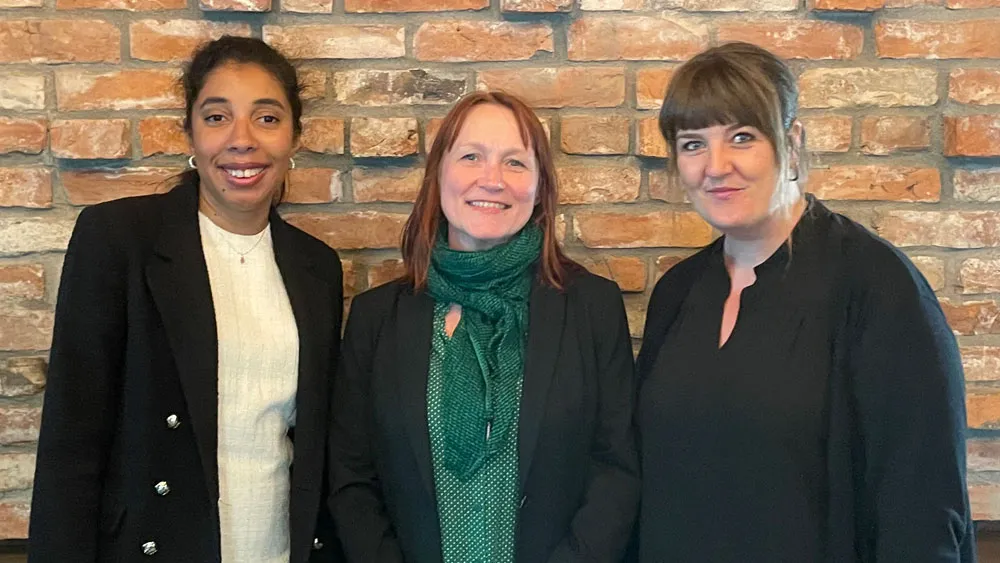
For the second year now, the Circle U. Knowledge Hubs have offered summer schools for B.A., M.A. and PhD students of all disciplines. Each school has been dedicated to the local Hub’s key theme - Climate in Berlin, Democracy in Oslo and Global Health in Paris. The Hub coordinators – Isabelle Mensching, Trine Kleven and Oumy Dramé – were in charge of the organisation, with Mensching overseeing the initiative as a whole. Here, the Humboldt-based work package lead shares what goes into the making of the popular summer programmes.
Behind the scenes with coordinator Isabelle Mensching
Today, the last of the Knowledge Hubs’ 2023 summer schools is ending. How did it go?
It’s been an exhausting but wonderful time. At the Berlin climate school, for example, we were fascinated by how motivated the students were and how, despite having really full, long (and very hot) days, they still worked in a concentrated manner, asked lots of questions and did amazingly well in their group tasks. And the ad-hoc feedback we got was overwhelmingly positive. Most said they thought the interdisciplinary aspect was beneficial to them, they thought it was interesting to see the different approaches. The social scientists were glad to have people on board who were good with numbers, because, for the UN simulation we did, they had to calculate what different levels of deforestation and afforestation would result in. The students also said they improved their cultural competencies.
The ad-hoc feedback we got was overwhelmingly positive. Most said they thought the interdisciplinary aspect was beneficial to them, they thought it was interesting to see the different approaches.
Can you walk us through the process from the grant agreement to the finished summer school?
For a summer school that happens in July or August, planning usually starts in September of the previous year. First, the three Hub coordinators meet - that is Oumy Dramé, Trine Kleven and myself. We try to see how many places we can offer, what can we each handle at our own universities. We look at how much time we will likely need for the admission and selection process, we try to set the dates and then I draw up a timeline for all three Hubs. Next, the Hubs get together individually to look at what the topics are, what the Chairs can offer and what they find interesting themselves. It takes several months for the programme to take shape. The application process for this year’s schools started in February. We advertise it with the help of our communication and dissemination work package, which requires coordination. Then, the local Circle U. team gets on the logistics, including the rooms, the social events and such.
In this big overall effort, what would you say is the biggest mountain to climb for you as the coordinator?
One of the most difficult tasks is the selection of the students. This includes filtering all applications before they get evaluated by the Chairs: We make sure the submissions are coming from within Circle U. – we also received applications from China, Iran and Pakistan. Then, we check their English levels and whether maybe there are PhD students who applied for a B.A. school. We also aim for a relatively even gender balance and a good mix of study programmes to make the schools really interdisciplinary. Then, our Chairs check all applications and we have one last meeting together to finalise the selection. Afterwards the coordinators take over again: We contact all universities and inform every student about their status – they receive their confirmation and rejection letters or get information on their waitlist placement.
We also aim for a relatively even gender balance and a good mix of study programmes to make the schools really interdisciplinary.
When organising such a programme across multiple European universities – are there challenges that stem from the diversity of the different institutions?
There definitely are. As a rather young alliance we still encounter some challenges when organizing joint formats. One of them is recognition issues: Some of our members are still unable to recognize the ECTS awarded for our summer schools. For some, the recognition of virtual components is not permitted – and virtual mobility is a vital element of many of our joint activities, including the summer schools. Some of our universities do not offer electives in their programmes or have really strict accreditation guidelines, whereby courses and modules have to be accredited years in advance. These partners are already working on solutions. In the upcoming project phase, the aim is to find procedures for Circle U. activities to be recognised by all partners.
For some, the recognition of virtual components is not permitted – and virtual mobility is a vital element of many of our joint activities, including the summer schools.
This was the second year for Circle U.’s summer schools. What are some lessons you’ve learnt along the way?
Structurally, I would say the biggest learning is that Circle U. has a lot to gain from the integration into existing structures of the member universities. To reach the big goals we have set ourselves, we need to find efficient ways to make even better use of the know-how we already have at our universities. Figuring this out in an alliance with nine universities takes time, but we will get there!
Another learning is that designing interdisciplinary schools with such diverse groups of participants is no mean feat. You have to find the balance so that it becomes a valuable experience for every student – no matter how new they are, depending on their different backgrounds, to the concepts, data or theories. It’s a challenge, but I’ve always liked challenges.
What’s your favourite part of organising the summer schools?
For me personally, the best part is the week in Berlin. It’s amazing to see how happy and excited the students are and how everything you've worked on for a year finally materialises. It is meaningful work: We organise something and people come and gain knowledge, networks and friendships. That makes it very different from writing 30 emails and then asking yourself ‘what even have I done today?’. I was also grateful for having colleagues I could vent to when things got really hectic. Oumy, Trine and I were a strong team and I believe we can be proud of what we have done with the summer schools these past two years.