Climate Change? LET’S BE THE CHANGE is led by Angelika Tangl, philosophy master’s student at the University of Vienna.
We’ve asked Angelika to share some insights about her project and what they are aiming to achieve this year. Let’s have a closer look at Climate Change? LET’S BE THE CHANGE.
What is your project about?
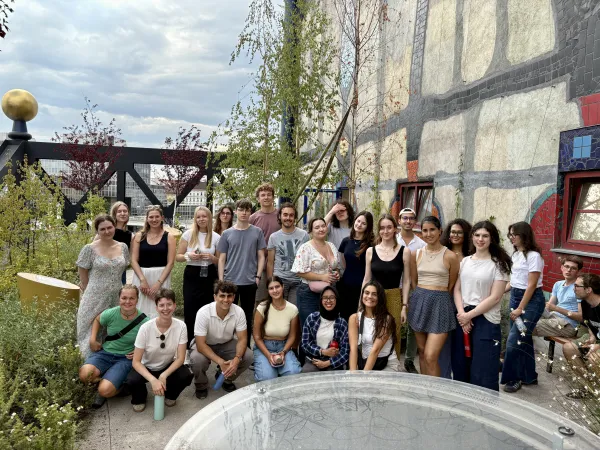
Our project was to host a student-led summer school that brought together 25 students from across Circle U. universities for one week at the University of Vienna. Our aim was to create a space for interdisciplinary, international exchange on climate action by students, for students. The programme consisted of student-designed lectures and workshops, as well as organised activities, tours of relevant institutions and talks on climate action by faculty members.
The project is not only about sharing knowledge, but about building a student network that strengthens our collective agency in the face of the climate crisis. What sets it apart is its collaborative structure on student level: every participant contributes actively to the programme and we share the responsibility for the programmes’ success. This shared ownership fosters a strong sense of connection, motivation, and critical reflection, as well as a shared ground for ideas and collaboration.
The initiative builds on the 2024 Circle U. summer school “Empowering Climate Action: Policy, Communication & Agency” in Berlin where we got to know one another, were inspired by the topic matter and felt the urgency to take action. This is how and why we formed this student initiative with peers from the nine Circle U. partner universities.
Why is this topic important?
The climate crisis is a scientific matter, a political challenge, a deeply human, ethical, and social issue that affects all of us. Growing up, we heard and learned about it as it unfolded further, and we’re now also witnessing the urgency of the climate crisis - alongside the frustration of institutional inertia. We see the potential for change, feel the desire to act, and we believe that collaboration across disciplines and borders is essential to unlock this potential.
Our actions are our power. We want to create a space in which students from different academic, cultural, and political contexts can come together to exchange perspectives, question assumptions, and imagine new ways of thinking and acting.
By taking initiative and shaping the summer school ourselves, we show that climate action can begin where we are: in our universities, in our networks, and in how we relate to one another. All of the student-led courses turned out to be highly interactive and included a task to take direct action, reaching out to CEOs of fast fashion brands, or reviewing governments’ actions regarding climate change. We don’t just want to talk about the climate crisis, we want to build structures that empower students to respond to it meaningfully and effectively.
What are you aiming to achieve with this project over the year?
Our central goal is to lay the foundation for a lasting international, student-driven network on climate action within the Circle U. alliance.
In the lead-up to the summer school, we joined as a team of students from all nine partner universities who contributed to the organisation and development of the programme. This collaborative process has already created strong ties and established a culture of mutual support and shared responsibility within the organising team.
The summer school itself is the main event as a concentrated moment of exchange, learning, and community-building. While we provide the opportunity to come together and enable international exchange during the one-week programme at the University of Vienna, the quality and intensity of this experience depend entirely on all the participants – those who chose to organise a course as well as those who prepared and engaged with the topics and materials of the courses. The result was an exceptionally intense and engaging experience, with 12 high-quality courses, one lecture by Fabio Lampert from the Philosophy Department at the University of Vienna, guided tours of the United Nations in Vienna and the Waste Incinerator Spittelau, and many evening activities of games, walking tours and cycle rides.
The summer school is meant as a beginning, and we hope to develop structures that allow for continuity, including opportunities for other interested students to take up and shape the initiative in new directions.
Explain in which way your project has an interdisciplinary approach.
Interdisciplinarity is the foundation of our project. Climate change is a complex and multifaceted challenge that cannot be addressed from a single academic perspective. That’s why our summer school brings together students from a wide range of disciplines and encourages them to contribute their unique viewpoints – whether from the humanities, social sciences, natural sciences, or technical fields.
Participants chose how they want to engage: as organisers, lecturers, facilitators, or active contributors. They don’t just attend interdisciplinary sessions, they create them. Each workshop or lecture is designed by students and based on a climate-related topic rooted in their academic background or personal interest. This leads to an incredibly rich programme with contributions from philosophy, economics, environmental sciences, pharmacy, literature, mechanical engineering, psychology, and more, and fosters cross-disciplinary discussion.
We believe that true interdisciplinarity means more than presenting perspectives side by side. It demands a willingness to question our own assumptions and to engage with unfamiliar frameworks, fostering the necessary cognitive flexibility and intellectual openness. Our project provides the possibility for us students to actively create the programme, follow our climate-related passions and take up space to teach and learn from one another.