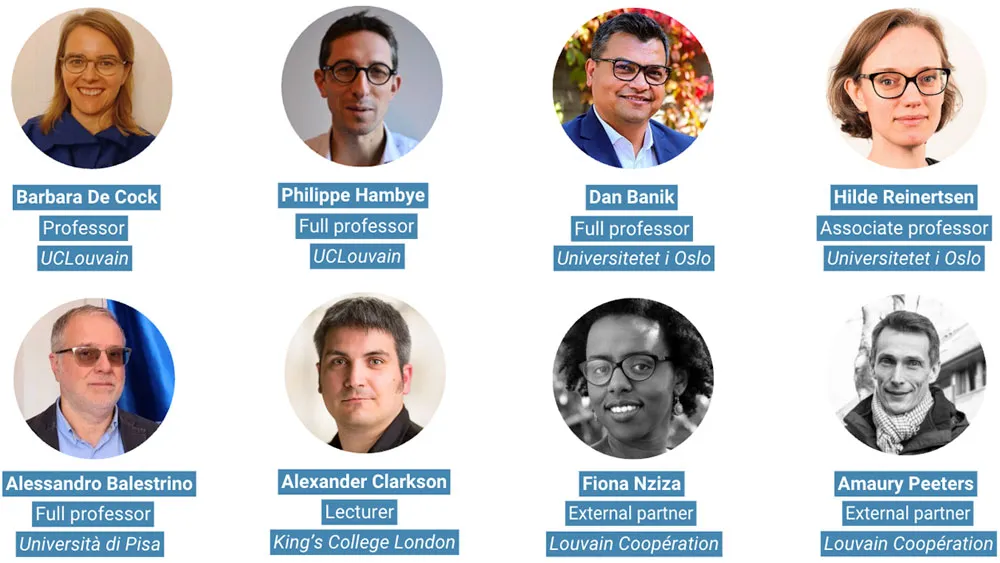
The project Confronting Poverty: Uniting Disciplines for Global Impact is led by Barbara De Cock, professor in Spanish linguistics at UCLouvain and Academic Chair for the Circle U. Democracy Knowledge Hub.
What is your project about?
The narratives of politicians, official instances, academia, NGOs and society at large about poverty and the assignment of responsibility for poverty in those discourses are intrinsically linked with the creation of reports and the formulation of poverty reduction policies. In this project, students and academic staff will critically explore these connections by analysing how the discourse on poverty influences policy design at three levels: nationally (within Circle U. countries), internationally (in relation to sustainable development and development aid) and locally (in terms of access to higher education and opportunities therein).
The following phenomena will be discussed:
- Who is represented as responsible? Is responsibility for poverty represented as relying on the poor (e.g. they don’t want to work), on the government (e.g. the government doesn’t take care), other actors?
- Which terms are used to discuss poverty and what do they imply as to how poverty is defined and measured? Indeed, poverty is being discussed in many ways¸ e.g. through discourse on social sustainability.
- Who intervenes in the discourse on poverty and in the policies concerning poverty, and who remains unheard, leading to ‘blind spots’ in policymaking?
Why is this topic important?
Poverty resonates across several of Circle U.’s knowledge hubs. In addition to undermining democratic participation and decision-making, poverty affects access to health and sanitation as well as severely undermining migrant integration and social cohesion. Moreover, people living in poverty are more heavily affected by climate change. Finally, poverty limits access to higher education and learning opportunities. Given the inherently interdisciplinary nature of these issues, the team involved in this project is interdisciplinary, involving colleagues from political science, European and International Studies, economics, history, discourse analysis, sociology of language, solidarity education & global citizenship, agroecology & development cooperation.
What are you aiming to achieve with this project?
In Spring, we’ll organise a UCLouvain research workshop involving students and colleagues from the participating universities, and local stakeholders, including an Open Conversation. This workshop will rotate over the next years among the participating universities, potentially evolving into a BIP. It will moreover be the starting point for a joint theme issue in an international journal. Our research results will also be disseminated towards civil society, among others through the organisation Louvain Coopération. Furthermore, we’ll create a mentorship system to encourage collaboration and mutual learning where students receive a mentor from a different Circle U. institution and discipline for regular online meetings.
In which way has your project an interdisciplinary approach?
Poverty is an issue that inherently touches on various disciplines and requires to be addressed taking into account these different aspects. The project thus involves colleagues from different disciplines, mainly from the fields of Arts and humanities, and Social sciences: political science (Dan Banik), European and International Studies (Alexander Clarkson), economics (Alessandro Balestrino), history (Hilde Reinertsen), discourse analysis (Barbara De Cock), sociology of language (Philippe Hambye), solidarity education & global citizenship (Fiona Nziza), agroecology & development cooperation (Amaury Peeters). The interdisciplinary mentorship program that will be launched in the context of this project will help the students become more acquainted with interdisciplinary approaches to the topics they are studying and/or working on.