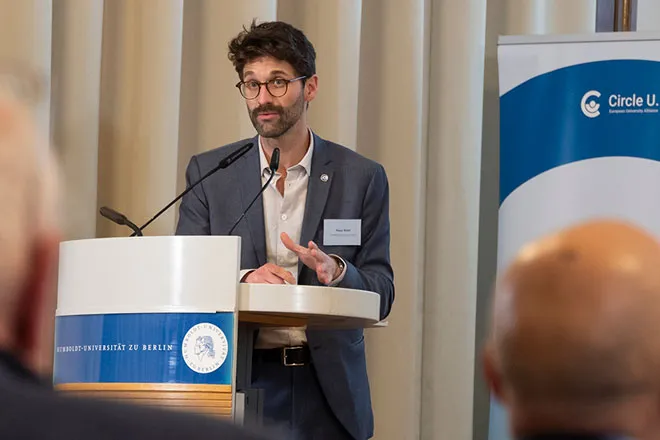
On 28-29 November, Humboldt-Universität zu Berlin hosted a Circle U. National Conference. The headquarters of the Knowledge Hub on Climate fittingly chose the European Green Deal as its topic. The conference brought the community in contact with members of politics, funding organisations and local initiatives pushing for sustainable change in the university context. Here is project coordinator Klaus Wiehl's recap!
Klaus, looking back at the conference, what are your biggest take-aways?
I found our public debate was particularly insightful. On the panel we had our university's president Julia von Blumenthal, the president of Germany's largest funding agency for mobility (DAAD) Joybrato Mukherjee, member of German national parliament Ruppert Stüwe and our Circle U. chair Anne Enderwitz from the The Circle U. Think and Do Tank on the Future of Higher Education. In the course of the debate it became clear that universities still are among the most trusted institutions in our societies. This comes with great responsibility - they are seen as role models with regard to the Green Deal. At the same time science is an energy- and travel-intensive endeavour.
One of my main take-aways is, that, next to finding an equilibrium between indispensable physical mobility and reducing universities' environmental impact, the topics of climate and sustainability should be included into every student's curriculum. Luckily, we have the opportunity to be in dialogue with very active students and student groups that specifically aim at making our universities more sustainable.
Only part of the conference was open to the public. Why is that and what was achieved during the closed sessions and workshops?
Yes, we had a number of meetings with just our Circle U. colleagues. We were discussing, internally, what the next project phase should look like. This also included questions of how Circle U. can implement the European Green Deal and make the biggest possible impact. We managed to further collect and organise our ideas for our proposal deadline coming up in January.
We also held workshops on two topics that are going to be especially relevant going forward. One of them is research assessment - as in, how is scientific output measured and what gets funded. That's an extremely important topic for researchers and for us, because as Circle U. we want to support sustainable career development for scientists, especially in the early stages of their careers. Together with the Berlin School of Public Engagement we also discussed how Circle U. can reach people beyond the university context and looked at some best practice examples.
What was your personal conference highlight and why?
The World Café was definitely a highlight! We had invited a number of local and HU initiatives promoting solutions to make our everyday more environmentally sustainable. It was an open and participatory format where the people running those initiatives were given a platform to present what they do. It was inspiring!
Another high point was the tombola. The team at HU had organized a huge number of prizes from different small upcycling companies and artists in Berlin. In total we collected 400 Euros that will go to Jyoti e.V., a young non-profit association that supports seamstresses in India, teaching them about their rights, business development, but also literacy.
Initiatives presented at the HU World Café
Student-led Sustainability Office, HU Berlin
A student led initiative at Humboldt-Universität whose goal is to develop concrete concepts that will promote institutionalised commitments to sustainability at HU.
Climate Protection Management, HU Berlin
The goal of the Climate Protection Management is to develop a climate protection concept for and with HU and is funded by the National Climate Initiative of the Federal Environment Ministry.
Environment, climate, energy: Research focus at Centre Marc Bloch
Uniting a wide range of disciplines, the CMB's researchers study historical legacies, changing territorial configurations, social challenges and transformations of public policies in the new context of global warming.
Integrative Research Institute on Transfomations of Human-Environment Systems (IRITHESys), HU Berlin
The Integrative Research Institute on Transformations of Human-Environment Systems fosters inter- and transdisciplinary research and projects related to land, water and energy use as well as food production and consumption, against the backdrop of climate change.
Circle U. Climate Change Knowledge Hub
Circle U. Knowledge Hubs are a space for both students and staff to co-create knowledge and solutions across disciplines and with external stakeholders, and to engage in policy development.
Circle U. Student Union
CUSU is a democratic body representing the student perspective in Circle U. The Union protects students' interests and delivers recommendations for the alliance's strategic direction.
DeepGreenGlass
DeepGreeGlass is a Berlin start up that re-purposes wine bottles by turning them into drinking glasses.