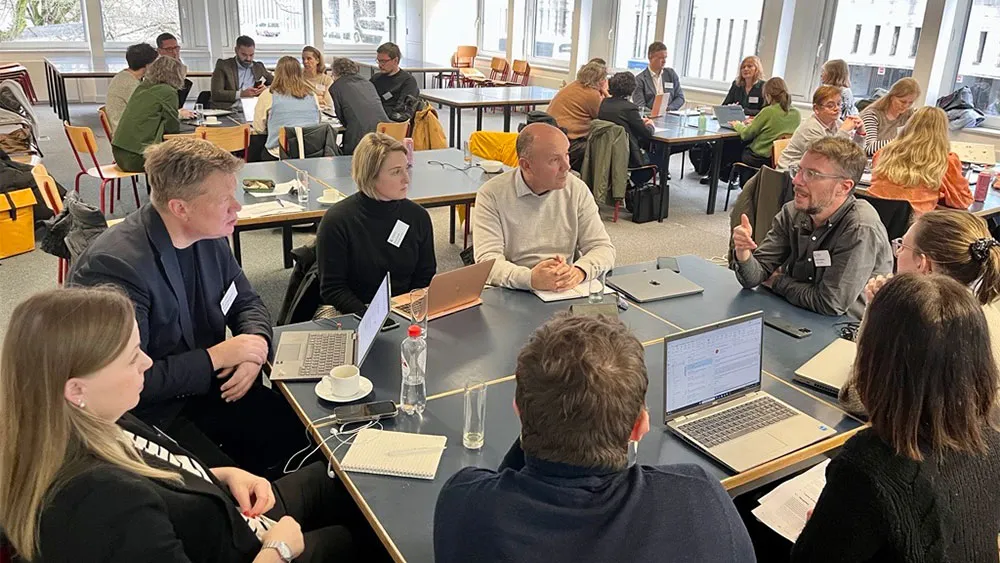
The senior management responsible for education (including vice-rectors and vice-presidents for education) were invited to take stock of the latest developments of the Open Campus and the alliance’s educational offerings. They were invited to discuss and explore ways to overcome existing hurdles for new courses, programmes and other educational opportunities. In parallel, Circle U. academic chairs as well as professors and researchers active in fields related to sustainability participated in a matchmaking event to create a series of more than 30 modules on this theme.
Automatic recognition and flexibilisation
In Circle U., from the very start of the alliance, recognition has been a top priority. Recognition is indeed a precondition to student mobility and more generally the development of joint offerings. An initial joint framework for recognition was developed and published in December 2021. However, with the first educational opportunities offered in Circle U., some obstacles have appeared making sometimes challenging to recognise the learning outcomes or the credits obtained by students after completing a programme, a module, a seminar.
While Circle U. aims to make automatic recognition a reality, participants first discussed their understanding of this goal. Automatic recognition does not exist per se, as there will always be a voluntary process to have learning outcomes recognised. However, it is fundamental that any educational opportunity offered in the alliance is recognised by all partners, considering the uniqueness of our cooperation, the very high quality of our joint offerings, the relevance of these initiatives. Senior leaders shared their experiences and practices of “automatic recognition”.
To do so, universities require more flexibility in designing and implementing the programmes, courses, modules and other learning opportunities. The diversification learning opportunities – in its formats, content, pedagogy, timing, outcomes, etc. – require universities to think out of the box, which requires flexibility and autonomy indeed. As reminded by the Circle U. Student Union, students are actually asking for a more and more diversified learning offer. The “traditional” BA and MA study programmes are not sufficient – or agile enough – to respond to their interests.

Experimenting unique interdisciplinary offering on sustainability
With the bachelor’s modules on sustainability, Circle U. is precisely aiming to respond to this demand. Academics from a broad range of fields (from environmental law, computer technologies, sustainable tourism, transportation engineering, war studies, plant science to urban management, ethical education and agroecology) engaged in an interdisciplinary ideation process to develop flexible modules or other educational collaborations on sustainability.
In one day only, participants connected and developed innovative ideas – from BIPs, joint modules and seminars, hybrid learning, collaborations with associated partners, study visits. More importantly, this matchmaking event demonstrated the importance to connect professors and researchers to think, debate and build joint educational opportunities for Circle U. students. While co-constructing the academic content of this upcoming joint offerings, participants have clearly indicated the necessity to develop new formats that will better answer the needs and interests of students.
Meeting and greeting our key partners
Circle U. is not the only European university alliance. Other alliances – namely Una Europa, CIVIS and Eutopia – were invited to present some flagship initiatives linked to education. Three years ago, Una Europa launched a bachelor programme on European studies. Despite the high interest, such a programme developed at BA level has been challenging. CIVIS was extremely proactive and successful in developing blended intensive programmes. But this would not have been possible without embedding these “new” programmes in existing ones. Eutopia has brought a broader – and more structural – picture how collaborations emerging from bottom-up initiatives are arising. Such a dialogue with other alliances is crucial for Circle U. as it opens new horizons, questions our practices and initiatives, inspires further developments.
Hilligje van’t Land, Secretary General of the International Association of Universities – an associate partner of Circle U., was invited to close the conference. She brought very interesting thoughts on the alliances and their impact in solving global challenges in a sustainable manner.