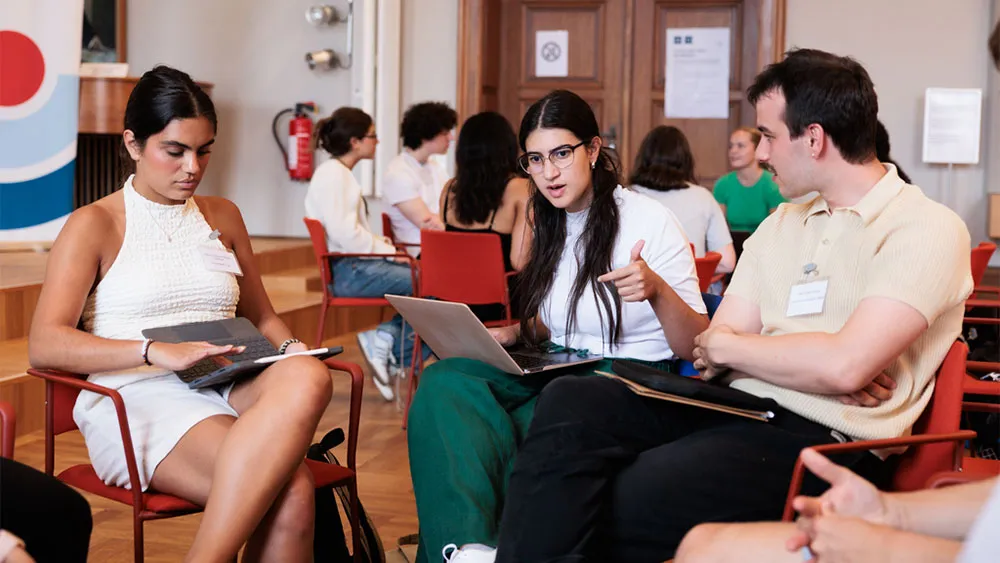
Blended online and on-site, interdisciplinary, international and hands-on: the summer school "Empowering Climate Action: Policy, Communication & Agency" was an out-of-the-ordinary experience for 36 undergraduate students and ten lecturers from across the alliance. Making use of the Erasmus+ Blended Intensive Programme scheme (europa.eu), it started with a week's worth of online teaching and conversations to introduce the participants to topics such as Climate Change Science, Environmental Psychology and Climate Policy. In this initial phase, working groups were formed and reading material assigned.
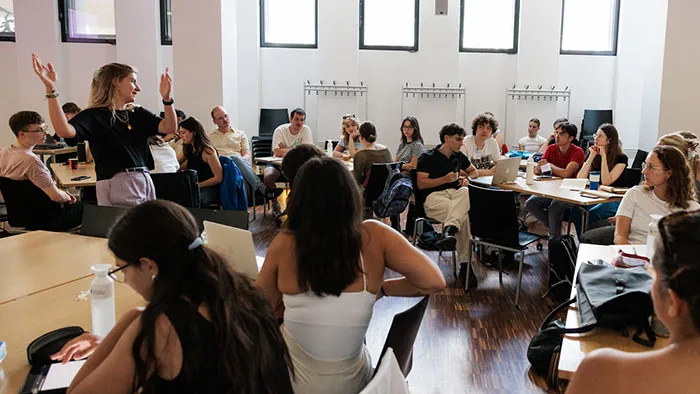
The week in Berlin, 22 through 26 July, then presented the main event: At Humboldt-Universität, the group got together not only for more lectures and workshops, but also intensified group sessions leading up to a simulation of UN climate negotiations as well as excursions to see the impacts of climate change in a local forest and to the German Bundestag. The schedule was demanding but also empowering – for students and lecturers alike.
The challenges of interdisciplinary teaching – and how to overcome them
"Organizing interdisciplinary teaching is a challenge for educators," says Hillary Briffa, Senior Lecturer in National Security Studies at King's College London and Circle U. Climate Chair. She elaborates: "We're navigating differences in disciplines and, in this case, different levels of experience and expertise at different levels of the BA programmes. We're also navigating different institutional cultures, with students from nine European universities – some of them exchange students. On top of that, the language we use is English, which is not the native language of the majority of the students participating."
Briffa is quick to add, however, that the challenge of climate change requires multidisciplinary approaches not only in research, but also in learning and teaching. In her perspective "nothing worth having comes easy". Having taught at last year's Climate Hub summer school as well, in her experience the success of such a programme hinges on the preparation: "From last year to this year, we have already improved and learned how to scaffold concepts, how much time group work takes in this setting and how to effectively incorporate active learning. Among faculty we have to ensure there is coherence and that we are working towards the same learning objectives."

Novel teaching formats to address novel problems
Looking at the week's programme, there are few traditional lectures to be found. Briffa explains: "Students will learn and retain more if they are involved in working through the material – we have the literature to prove it." So, rather than explain how difficult it is for countries to reach agreements on different policies on climate emissions or deforestation, she has students take on the roles of delegates from the EU and states like China and India, and have a go at negotiating themselves – an exercise that proved especially popular with the group.
For the debrief at the end of the summer school, the team brought a board game designed by Jon-Erik Dahlin at KCL's Department of Engineering. "Dilemmas" (jonerikdahlin.com) was supposed to, once more, activate the students who, playing against each other in pairs, got to revise their interdisciplinary knowledge. In this game, when a team lands on a "dilemma" square, two teams get to debate a question (such as: "Should we build more high-rises?"), with a third team adjudicating. Briffa says: "It makes them think through the arguments themselves and train transferable skills, such as having constructive discussions and lobbying for what they believe in."
An opportunity for early career researchers
The teaching team working together at the summer school was diverse – not only regarding disciplines and nationalities, but also in terms of seniority. For Lilli Rupprechter, a PhD researcher at King's College London's Department of Geography, it was the first time teaching a group of this size. "Last year, I took part in an interdisciplinary Circle U. training programme for PhDs in Aarhus. It was really helpful for my project – and I met Hillary, who invited me here," she says.
Rupprechter was able to bring fresh research-based teaching to the programme: She has extensive experience in climate communication for the Austrian government and is currently designing training resources to help academics engage with policy makers, which made her a perfect fit. At the school, she shared her expertise in a lecture on "Climate Policy and its Challenges" and a workshop on policy papers.
New networks and synergies beyond the summer school
Briffa, who is now in her second year as Circle U. Climate Chair, says the alliance and its Climate Hub have brought along valuable networking opportunities: "It's been fantastic to engage with colleagues and peers from across European institutions, especially in a post-Brexit environment in the United Kingdom." It brought her together, for example, with fellow Climate Chair Marcel Robischon, a professor in Agroecology at Humboldt-Universität and another recurring lecturer at the Berlin summer school.
As the programme is nearing its ending, Briffa and Robischon are already plotting their next collaboration: "Our fields sound like they are extremely far apart, but we've discovered we have a shared interest in how Agroecology and National Security Studies converge in islands. That's what led us to organize a public event on climate change as part of Berlin Science Week." On the same day, November 5, they are also planning to offer a virtual Climate Hub Happy Hour Event, where PhD students will present their work on related topics.