PICTURE is led by Lauren Pankin, a PhD candidate at Université Paris Cité. The research team includes experts from Université Paris Cité, University of Pisa, Humboldt-Universität zu Berlin, King’s College London.
We’ve asked Lauren to share some insights about her project and what they are aiming to achieve this year. Let’s have a closer look at PICTURE.
What is your project about?
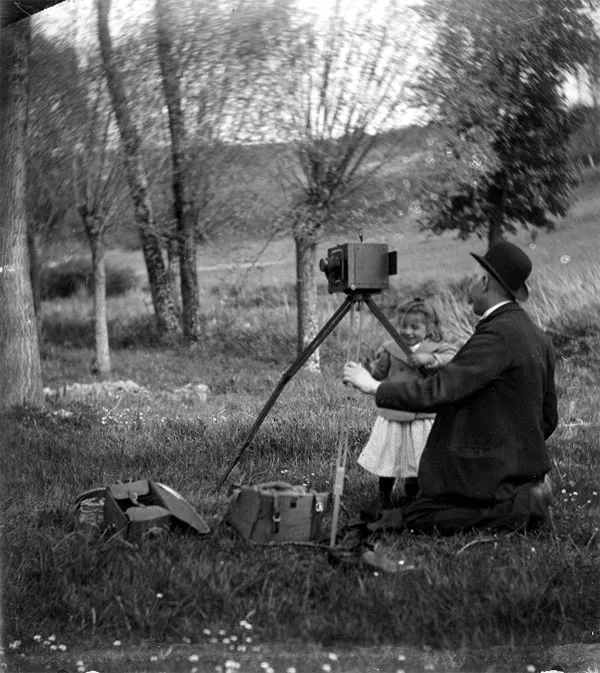
PICTURE is an international research seminar on rural photography in Europe during the long 19th century. Historically, the field of photographic history has been heavily focused on urban environments, but rural photography is a rich, and largely unexplored, area of research. This first edition of the project will focus specifically on the theme of photography and the environment. We aim to explore how photography was used not only to document changes in the natural and human-built rural landscape, but also a social and cultural tool to actively imagine and shape these environments. BY examining the visual and artistic traditions of Europe, alongside scientific and technological practices, we will produce original research culminating in a conference, an exhibition, and hopefully a publication in 2026.
Why is this topic important?
At a time when agriculture was being radically transformed by the Second Industrial Revolution, photography captured a crucial tension between a romanticized, pastoral past and a mechanized, rationalized future. This project’s approach allows us to examine the topic across different scales, from the micro-level of individual farms and local environments to the macro-level of national identity and global circulations of agricultural, artistic, or scientific information, ideas, and power. By studying how rural environments were visually represented in photographs, as well as the ideologies, networks, and material culture structuring these photographic processes, we can better understand the historical construction of rural space and place. Furthermore, by drawing from case studies from all over Europe, including Great Britain, Romania, Italy, and Germany, we hope to investigate the role of rural representations in the construction of regional, national, or European identity and explore the diverse meanings of rurality across the continent.
What are you aiming to achieve with this project over the year?
The project will be carried out over a series of activities. It began in the spring with a series of online workshops held to discuss methodological approaches and sources—an essential discussion, since the aim of this project is to equip early career and curious researchers with a more rigorous understanding of how photography studies can be used in historical inquiry (and some researchers are working with photographs for the first time, or as part of a larger project not necessarily focused on photographs). These workshop sessions help researchers to develop their projects in preparation for an in-person conference in November, which will be held at Université Paris Cité. An exhibition will also be held at the Bibliothèque Universitaire Grands Moulins which displays some of the photographs discussed in the symposium and in workshops.
Explain in which way your project has an interdisciplinary approach.
PICTURE considers interdisciplinarity to be the core of successful historical research. We selected this year’s topic, the environment in rural photography, because it necessitates an engagement not only with the history of art and photography, but also with environmental studies, the history of science, and geography. All of our participants have thus far employed interdisciplinary approaches in their case studies, interacting also with historical subdisciplines such as war history, the history of tourism, the history of the bourgeoisie, and intellectual history. During the workshop sessions, readings were selected to represent a wide range of theory and methodology potentially useful to the researchers’ projects. We also have ensured that the sources are drawn from a variety of archives not only across Europe, but across disciplinary boundaries (e.g. museums; national, university, commercial, private, and scientific archives). We encourage reflections on the different contexts of photographic production, including institutional, scientific, military, artistic, and vernacular photography. This interdisciplinarity is reinforced by the four organizers’ different approaches to photography, including maritime history, agricultural history, visual culture studies, and performance studies.