The potential for joint research on climate is great within Circle U. Marnik Vanclooster, Professor of Bioengineering at UCLouvain and Circle U. Climate Chair has done the math: He looked at all publications from the last ten years by researchers from Circle U. universities that tackled climate questions. The result? “We found more than 10,000 publications, implying a huge diversity of research questions and approaches from various disciplines,” he says. “Each of these publications had, on average, four to five authors. This means that a huge number of people worked on climate issues within Circle U. in the last ten years!”
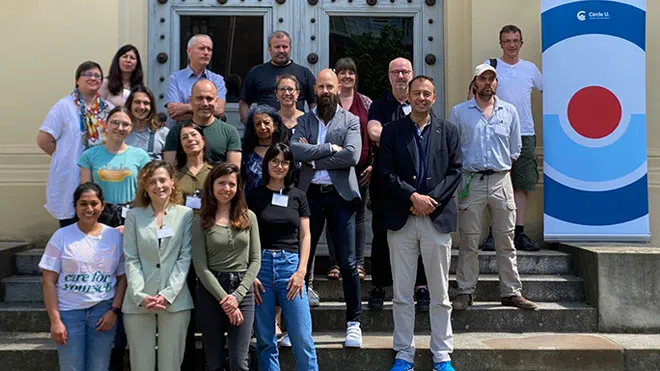
On 6 and 7 June 2023, Circle U.’s Climate Hub brought together sample of 37 researchers of all career stages and from all over the alliance to present and discuss their work. This year’s topic: Climate Change and Water. The aim of the event, once more, was to foster interdisciplinary connections and take another step towards a joint research agenda. Humboldt-Universität zu Berlin’s vice president for research, Christoph Schneider – himself a climate expert – welcomed the participants hailing from all nine partner universities, to Berlin.
A step towards true interdisciplinarity
Over the following two days, 28 presentations covered topics ranging from the loss of lake ice cover in the northern hemisphere via the effects of temperature on groundwater ecosystems, to nature-based solutions for flood-resilient cities and questions of land- and water-right in environmental policy. The participants themselves came from various disciplines including Physics, Chemistry, Biology and engineering as well as Geography, Sociology and even Literary Science. And, as the organisers add, the event showed that the Knowledge Hub is beginning to grow beyond the Circle U. Chairs and their own research teams.

This in itself is a small victory, as getting the right people together, in one room, to have meaningful discussions and foster networks for interdisciplinary collaboration is no small feat. Circle U. Chair Alexandre Gélabert from Université Paris Cité admits that even for him, it’s sometimes hard to think outside the boundaries of his own discipline: “I'm a chemist and very specialised and sometimes it's hard to see the bigger picture which includes, for example the perspective of the social sciences and the humanities.” He is adamant, however, that this is what needs to happen. “You often see people working side-by-side, but their research questions are not designed in a truly interdisciplinary way. It's super complex,” he says, “but it’s what we need to do if we want to propose solutions to policymakers and society. So, this seminar is a step in the right direction.”
Early career researchers’ voices
In fact, the Thematic Seminar is encouraging early career researchers especially to start thinking beyond the confines of their own disciplines and their respective methods. Pratiksha Acharya is just embarking on year two of her PhD and refers to herself as “a child in academia, just a crawling toddler”. At the seminar, she presented her work on food-chain cycles and loss of biodiversity in fresh water streams. She signed up for the seminar because she finds her research is related to the greater topic of climate change. “It was great to get different perspectives,” she says, “because here it’s not only ecologists but also hydrologists and people from the social sciences. I got some valuable feedback on my project!” She also admits that the exchange with scientists from different backgrounds was challenging: “It was very different from what I had imagined - I didn't know that this seminar would be so extremely diverse, sometimes to the point of it being difficult to find common ground.” She did, however, make some connections and hopes they will stay in touch to work together in he future.

Also there to discuss her research and get inspired to broaden her academic horizon is Erika Pasciucco from the Università di Pisa. “I’m a chemist, so my life is in the lab,” she says. For her PhD she is looking for ways to remove contaminants from tanning waste water. She explains that the impact of the leather industry is a global issue – not only because the waste products of the tanning process are toxic to aquatic and plant life, but also because animal farming has a significant carbon footprint and pesticides and fertilisers are used in the growing of animal feed. Erika says that, beyond her own work, she sees the societal dimension of the topic: “I think about the impact of people's choices, for example. A pair of shoes made of real leather - it's a choice and a social problem.” This is where she sees the value of this exchange between disciplines – and potential to join forces in the future.