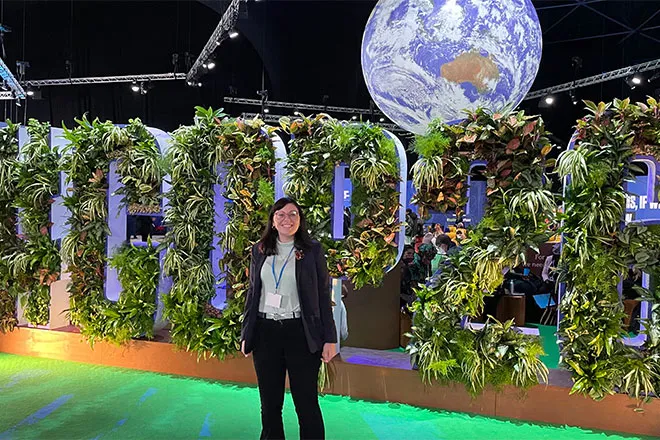
Yuliya Samofalova (30) is working on a PhD in Environmental Communication at UCLouvain. Together with a peer from Italy, she has just published her first research paper in “Language Learning and Higher Education" (degruyter.com) – one outcome of teaching a virtual seminar at HU Berlin last winter.
Samofalova holds a graduate degree in educational science and had previously gained plenty of experience teaching English abroad, but was now interested in combining her pedagogical skills and curiosity with the research she was doing. “With my fellowship, I don’t automatically get to teach, so when I saw the call from Humboldt to lead a Circle U. Team, it was the perfect opportunity – and I was so happy when I got accepted!”
What are Circle U. Teams?
Circle U. Teams (hu-berlin.de) are an iteration of Humboldt-Universität’s Q-Teams, a teaching format which was first introduced in 2012 and opened to the Circle U. community in the winter term of 2021/2022. The idea is to give early career researchers the training and the opportunity to teach international and interdisciplinary seminars that are open alliance-wide. For students, they provide a glimpse into the world of research as they learn about their instructor’s work and conduct their own research projects in small groups.
“The teams are research-based and student-centered. To make this work, we accompany the young lecturers from start to finish,” says Laura Schilow, who is in charge of the programme. “They are given introductions to research-based teaching, didactics for higher education and digital formats. The lecturers are also matched with a professor who acts as a point of contact throughout the semester.”
A student’s perspective
The class that Samofalova taught last year, “Climate Communication Instagram”, proved to be seminal for some of the students: Anna Zelger (28), now in her first semester of a Master in Information Science, says it was her first encounter with mixed-method research.
In a group with four other students, she analysed Instagram posts made by an activist group. They used coding developed by Samofalova and her colleagues, as well as their own qualitative parameters. “I had never worked with qualitative or data mining techniques before, but some of the others in my group – mostly the social scientists – had.” Zelger says she has learned methods she can now apply in other contexts, such as a seminar on open science monitoring she is taking this semester.
From research to teaching – and back again
As the winter term was coming to an end, Samofalova and an Italian peer from Università della Calabria currently working at UCLouvain compared the evaluation forms of the seminars they had each been teaching. Out of this comparison, their joint research paper was born.
“Interestingly, about 15 percent of students said that their awareness of climate change problems had grown after taking part in the Circle U. Team – even though climate change was not the main topic!” This led Samofalova and her colleague to the hypothesis that research-based learning has the potential to motivate students to learn more – be it about climate change or other topics. “There have been papers examining this kind of correlation for the natural sciences, but not for social sciences and the humanities.” For her, a researcher who is used to working with methodology and data from fields as diverse as psychology and communication science, the findings are particularly salient.
New teaching formats – what’s next?
Currently, there are two Circle U. Teams running: "Democracy, Bildung and Decolonialization in Afro-Brazilian Capoeira", taught by David Sebastian Contreras (Humboldt) and "We, the global governors", by Milan Varda (University of Belgrade). Participating students are based at Université Paris Cité, King’s College London and Humboldt-Universität. The positive outcomes and feedback from both lecturers and students suggest there is a lot to be taken from this experiment - and Circle U. is continuing to trial and promote new and progressive teaching formats.
The next opportunities for (future) educators to upgrade their skills are offered by Aarhus University: “International co-teaching – Integrating Virtual Exchange into the University Classroom” (au.dk) (9-19 January, again on 11-20 September) spans approximately eight hours over the course of ten days. Sign up now and watch this space!