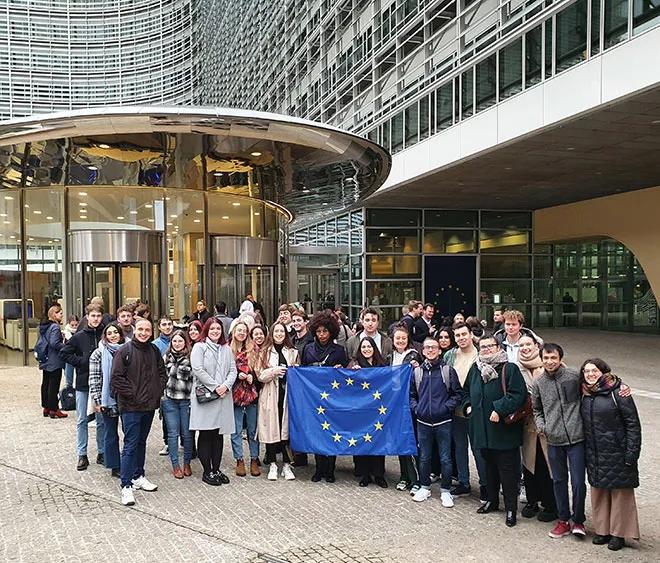
A three-day seminar took place in November with Master students from UCLouvain and Humboldt-Universität zu Berlin - under the auspices of the Circle U. European University Alliance - on the theme “The EU and Eastern Europe: Peace, Democracy and Cooperation”. This activity was organized by Prof. Edoardo Traversa (UCLouvain) and Dr. Claudia Matthes (Humboldt-Universität zu Berlin), Circle U. Academic Chairs in Democracy and Public Governance.
Learning put into practice
On the first day, students exchanged with academic experts from UCLouvain and the University of Belgrade on the geopolitical stakes of EU Eastern policy, followed by a dialogue with a Member of the Cabinet of European Commission President von der Leyen.
The learnings were put in practice in the second day, as students simulated a European Council agenda point on the Ukrainian candidacy to the EU: they took on the role of different Member States, EU bodies and Institutions and discussed the prospects of Ukraine's accession to the EU.
The last day provided the opportunity to compare the experience with that of practitioners with visits to the EU institutions. The European Commission prepared a cross-Directorate Generals (DG) programme with speakers from the DG for Neighbourhood and Enlargement Negotiations (DG NEAR), DG for Budget (DG BUDG) and the legal service, to explain the role of the European Commission and the current state of play in the region. The trip concluded with a visit to the Permanent Representation of Belgium to the EU where a wider outlook on foreign affairs was presented including on the relations with the UK, the EFTA countries, and the Holy See, as well as the work of the Committee for Civilian Aspects of Crisis Management (CivCom) and of the Politico-Military Group (PMG).
Testimonials from the students
Justine Vizier, Université catholique de Louvain:
– These 3 days organised by UCLouvain and Humboldt University were truly amazing. I was glad to meet and work with my peers during a challenging simulation on the accession of Ukraine to the EU. The European Union is not only a theoretical affair but must be lived to the fullest in order to shape it for the better tomorrow.
Tom Rose, Humboldt-Universität zu Berlin:
– The three-day block seminar in Brussels/Louvain-la-Neuve was a fantastic opportunity to deepen our understanding of the functioning of the European Union within the context of enlargement and the ongoing Ukraine crisis. Not only were the lectures informative, but the simulation allowed us to develop our practical and negotiation skills in a cross-cultural international setting, complemented by the opportunity to hear from real-life stakeholders from within the European institutions and the Belgian EU Representation.
Hugo Chesnier, Université catholique de Louvain:
– This European week was very instructive, the different conferences in Saint-Louis and at the Commission gave us a better understanding of the issues facing the European Union. Similarly, the simulation of the European Council allowed us to put into practice the knowledge we had learned in class and thus to find a real use for the different notions seen during the semester. Finally, spending this week with students from the Humboldt University in Berlin enabled us to be confronted with other visions and approaches to European issues.
Thank you!
Many thanks to the speakers for their contribution and to the European Commission and the Permanent Representation for hosting our group. This cross-university programme would not have been possible without the European Universities initiative, supported by the European Commission.