As is often the case with events where people come together to discuss significant challenges, the conference rounded out with more questions than answers. This is the primary purpose of these spaces, to allow questions to emerge and for researchers to come together and discuss issues more deeply and form collaborative partnerships on the quest to answering these questions and providing solutions for these challenges.
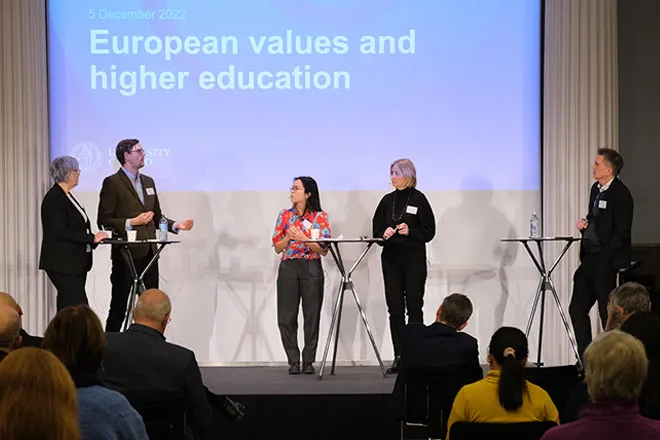
European values and higher education
The first day covered issues of quality assurance and academic freedom in the European Higher Education Area (EHEA), featuring keynotes from this year's awardee for the University of Oslo's Human Rights Award, Andrea Petö, a professor of gender studies at the Central European University, and UiO's Jens Jungblut from the Department of Political Science. A debate followed, featuring the two keynote speakers, Ina Maria Finnerud from the National Union of Students of Norway, and the Chief Executive for NOKUT, Kristin Vinje.
Dr. Petö is an incredible speaker: she is sharp in intellect, direct, and can insert humor into a dark topic. She urged us to keep our eyes open to the red flags indicating when governments begin to infringe on academic freedom - we can't "sleepwalk" through our work, she argues, ignoring what is in and around our institutional systems. The keynote set the debate up well for a discussion on how quality assurance functions in the EHEA and its relationship to academic freedom. Two thoughts emerged as the closest we came to in terms of conclusions: First, it is possible that safeguarding academic freedom is not solely an issue for quality assurance. Second, trusting political systems to hold institutions and people accountable works only until illiberal forces take hold of those political systems.
War in Ukraine and its implications for Europe
On the second day, conference participants listened to three keynotes on topics related to war, geared towards discussing issues around the current war between Ukraine and Russia. Stipe Odak from the Université Catholique de Louvain discussed memories of war; Gert Tinggaard Svendsen from Aarhus Universitet delivered a lecture on levels of trust developed in Scandinavian societies in previous centuries which likely contributed to the peacefully societies of these countries today; and Iver B. Neuman from the Fridtjof Nansen Institut provided historical context to discuss the war today, and what we might expect moving forward.
In the roundtable sessions that followed the keynotes, I spent most of the time at the roundtable focused on social trust. It was during these smaller discussions when participants dug deeper into the topics and began to grapple with more specific questions: How does a government support its people to enable social trust? What happens when members of the external community enter? If a group of people in a society trust one another and their social trust is built on cultural understanding, or agreed-upon values, what happens when new members join their society with different customs? Would building social trust prevent crises such as the war between Ukraine and Russia, further preventing the trauma in memories of war?
European values in times of upheaval
At the root of these questions, I believe, is the question the conference was trying to observe generally: If we can agree on common values, does this ensure a more peaceful society? As Jens Jungblut said towards the end of the debate on the first day, how do we hold our institutions accountable to our values when we don't have concrete definitions of those values? And what if "European values" are not just "European," as my classmate from a non-European, non-Western country pointed out our reflections on the conference?
Moving forward, I hope to see more student involvement at these events. There were possibilities not just for students to learn, but to be inspired and become curious. Such events offer possibilities for students and professors from both the same and different academic backgrounds to tackle these topics from different angles, forming a prime space for interdisciplinary, informal learning. And importantly, the topics at hand are relevant to students of today who will be those facing consequences in the future, as well as making decisions to deal with those consequences.
Kelly is in her third semester of the MPhil in Higher Education program at the University of Oslo.