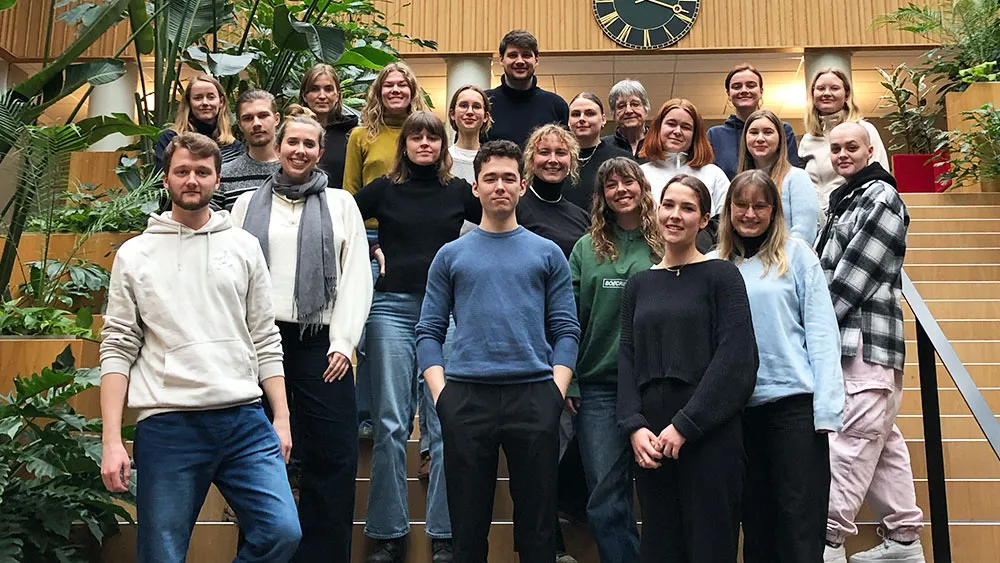
The workshop from 11th to 12th of March, took place at the Danish School of Education (DPU), in Copenhagen. Students from the course “Anthropology of Organizations” at the DPU, which is a part of Aarhus University, as well as we, students from Berlin, participated in this workshop. We were approximately 30 students from different educational backgrounds, which contributed to an interdisciplinary learning environment and a unique experience.

Student engagement
Together with Susan Wright, a professor for Educational Anthropology at DPU, we were able to organize a workshop on how universities can play an important role for a sustainable, social and just transition of the society. We talked to the students at DPU before coming to Copenhagen in order to get an idea on what they are interested in. It became clear that they were mainly interested in student engagement and what is needed to transform an idea into a project. Therefore, we created a participatory workshop around these topics, focusing on a project-based and creative learning environment.
Guided visualization
On the first day of the workshop, we started by introducing everyone with a few games. After that, we gave an introductory presentation on the theory and concepts of sustainability in general and why we as universities play an important role within the Sustainable Development Goals (SDGs).

We introduced the concept of Education for a Sustainable Development (ESD) and discussed the idea of student engagement within this context, by presenting the work of the student initiative “Sustainability Office HU”. After a quick lunch break, we wanted to give the students the chance to imagine a future campus that consists of a more open, social and sustainable learning environment. We did this by using a so-called “guided visualization” to collect visions of the students.
After writing and painting our ideas and discussing them in class, we went on a city tour in the afternoon with a focus on “sustainability in the city” that was organized by the students from DPU. The tour was very inspiring, as we visited community gardens, recycling cafés and other spaces that showed us the engagement within the field of sustainability of the citizens in Copenhagen. We ended the tour by eating at a beautiful restaurant and chatting about the experiences we have made so far.

On the second day, we focused on project-based learning. For the first two blocks, we tried to transform the visions from the first day into actual project ideas. This worked out very well, since many students had concrete projects in mind. In the last block of the workshop, we did a “method circle training” which gave the students the tools and knowledge to actually pursue with these projects (stakeholder analysis, a timeline and an influence vs. interest matrix).
Exceptional learning space
After this we ended the workshop with a quick evaluation round. The feedback was great, especially Professor Wright said that she “learnt a lot about how to prepare and run a workshop, in addition to the material on sustainability and the tools you used to organize your projects.” We are still in contact since she invited us to speak at another event in May. She also told us that many students are enthusiastic to work on the projects that we collected in the workshop, and some have already reached out to other important agents of the universities to pursue with their projects.

This workshop was definitely a great experience for everyone who was involved. The peer-to-peer learning environment created an exceptional learning space on equal terms with openness and fun, which made everyone feel comfortable and seen. Without the funding of the Circle U. and their great work on international collaboration, this workshop would have not been possible. Therefore, we would like to thank the Circle U. in the name of all participants of this workshop, as well as the main organizers Torben Rode, Anna Hinderer and Prof. Susan Wright.
The Sustainability Office
For more information on the sustainability office please visit the Nachhaltigkeitsbüro / Sustainability Office (hu-berlin.de).
Feel free to contact us via mail: nachhaltigkeitsbuero@hu-berlin.de