- Lecturers: Kristin Soraya Batmanghelichi (Modern Iranian Studies, University of Oslo), Teresa Pepe (Arabic Language and Culture, University of Oslo), Amany Abdelrazek-Alsiefy (Transdisciplinary Gender Studies, Humboldt-Universität zu Berlin)
- Teaching period: Teaching period: Four virtual sessions between 17 November 2025 and 28 January 2026, hybrid workshop on 14 and 15 January 2026.
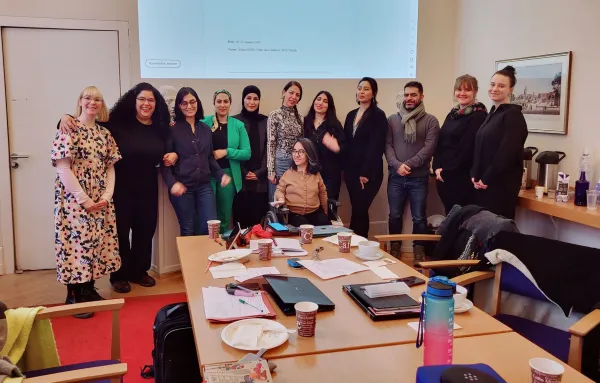
Women on the Go: Contemporary Discourses and (R)Presentations across SWANA
What happens when women from the Southwest Asia and North Africa (SWANA) region reclaim their own stories? Between October 2025 and January 2026, students and scholars from Humboldt-Universität zu Berlin and the University of Oslo came together to find out. "Women on the Go" was a three-month COIL collaboration that asked an urgent question: how are women from South West Asia and North Africa represented in literature, media, and digital spaces – and who gets to speak for them?
The course moved between screens and seminar rooms. Students met virtually across borders, then convened in Berlin for a two-day hybrid workshop featuring keynote lectures from leading scholars, graduate research panels, and an intimate conversation with award-winning writer-translators. Students examined how contemporary women writers and artists challenge orientalist tropes, reclaim bodily autonomy, and build feminist solidarities across digital networks. The result was not simply a course, but a transnational academic community – built on sustained dialogue, peer mentorship, and a shared commitment to decolonizing knowledge production.
Cross-Linguistic Speech Perception and Language Attitudes: A Collaborative COIL Seminar
Why do so many of us end up with an accent when we learn a language after we've grown up? In this joint seminar with multilingual students from Berlin, Cologne and Paris, participants had a lively discussion about what affects how people pronounce a second language, with a special focus on how people hear speech, during online classes. They then looked into why some languages sound beautiful and others harsh and unpleasant from different angles during their workshop in Cologne.
There was lots of group work on hypothetical projects, which involved research questions, experimental design with expected results and discussion. Participants said it was great getting to know each other and swapping stories about their different academic backgrounds. Joint visits to the beautiful Cologne Christmas markets were a real highlight.

- Lecturers: Christine Mooshammer (German Linguistics, Humboldt-Universität zu Berlin), Ioana Chitoran (Linguistics, Université Paris Cité)
- Teaching period: Weekly online sessions between 16 October and 27 November 2025, in-person workshop 3 to 5 December 2025.
- Lecturers: Amany Abdelrazek-Alsiefy (Gender and Cultural Studies, Humboldt-Universität zu Berlin), Kristin Soraya Batmanghelichi (Modern Iranian Studies, University of Oslo)
- Teaching period: 1 November 2024 – 31 January 2025 (in person on 20 and 21 January 2025)
Body Aesthetics and Challenging Boundaries in the Contemporary MENA Region
The interdisciplinary project "Body Aesthetics and Challenging Boundaries in the Contemporary MENA Region" united Master’s students from Humboldt-Universität zu Berlin and the University of Oslo through joint courses, including "Exploring Masculinity and Power Dynamics in the Contemporary MENA Region" and "Gender and Revolutions: Rethinking the 'Woman Question' in the Modern Middle East."
This collaboration between the Center for Transdisciplinary Gender Studies (ZTG) and the Department of Culture Studies and Oriental Languages (IKOS) began with a series of online sessions and hybrid lectures. It culminated in a two-day workshop, "Inroads and Transitions: Gender, Religion, and Identity in the Contemporary MENA Region", hosted in Berlin.
The programme was significantly enriched by scholars from Circle U. partner institutions, including Aarhus University and King’s College London. Their participation fostered a unique transnational dialogue, introducing critical perspectives on gender, sexuality, and body politics. This initiative provided a dynamic platform for academic exchange, highlighting the profound value of international and interdisciplinary cooperation in advancing the study of the Middle East and North Africa.
DIVIMEC – Digital and Visual Media Cultures in South Asia and Beyond
The DIVIMEC project, funded by Circle U.’s COIL initiative, brings together students and faculty from Humboldt-Universität zu Berlin, Aarhus University, the University of Vienna, and King’s College London to collaboratively explore the profound societal transformations triggered by South Asia’s digital revolutions. While technology has opened new opportunities for communication, education, and activism, it has also deepened existing inequalities- particularly among marginalized communities.
Recognizing these complexities, DIVIMEC uses COIL formats to foster inclusive, research-based learning environments that connect classrooms across borders. This approach enables students to engage critically with case studies from India, Bangladesh, Nepal, Pakistan, and diaspora communities in Europe, while also reflecting on global challenges such as digital divides, AI developments, and the democratic implications of digital and visual media. Through joint teaching, intercultural exchange, and collaborative research, DIVIMEC aims to build long-term academic partnerships and empower the next generation to navigate and shape our increasingly interconnected digital worlds.
- Lecturers: Nadja-Christina Schneider (South Asian Societies and Cultures, Humboldt-Universität zu Berlin), Uwe Skoda (India and South Asia Studies, Aarhus University), Manuela Ciotti (Social and Cultural Anthropology of the Global South, University of Vienna), Munira Cheema (Media, Culture and Creative Industries, King’s College London)
- Teaching period: seven 60-minute sessions between 23 October and 11 December 2024

- Lecturers: Henning Nuissl (Applied Geography, Huboldt-Universität zu Berlin), Kerstin Krellenberg (Urban Studies, University of Vienna), Julia Wesely (Urban Studies, University of Vienna)
- Teaching period: online session on 29 April 2025, in-person group work 2 to 6 June and 13 to 20 July 2025.
Comparative perspectives on local democracy and climate change adaptation
The course “Comparative perspectives on local democracy and climate adaptation” was developed for Bachelor's and Master's students in the field of geography at the University of Vienna and Humboldt-Universität zu Berlin. The course included teaching sessions at the respective universities, joint online sessions via Zoom and independent group work, as well as five to eight days of field visits to Vienna and Berlin.
The course content focused on local democratic processes for climate change adaptation, which were examined comparatively and from interdisciplinary perspectives in the two cities. The students' task was to work intensively in inter-university teams on a selected sub-topic related to local democratic processes for climate change adaptation. This included, for example, the scalar dimension of climate-just urban development, and citizen participation in climate adaptation programmes.
The Circle U. COIL funding enabled the detailed documentation, reflection and evaluation of the course, resulting in a Guide that can be used by university lecturers who consider developing, or are already designing, a similar comparative course.
Post-Conflict Transitional Justice in Myanmar – Methods for Collaborative International Learning
Collaborative online classrooms are about creating open and accessible environments that encourage learning together. The digital space, with its much more porous national borders, offers many opportunities for international learning, but also carries the risk of surveillance and intrusion by authoritarian regimes and their mobs.
Creating digitally safe online spaces is therefore very important, but has rarely been addressed by higher education institutions. What can academics do to protect their students from this threat? And how can we remain open in our approach to teaching and use collaborative online learning methods while creating digitally safe(r) online classrooms?
Accompanying the Seminar "Post-Conflict Transitional Justice in Myanmar", which was taught by two persecuted scholars in Myanmar, we offered a three-hour session with the title "Making collaborative online learning possible for students at risk - A best practice workshop" on 12 February 2025. It offered an opportunity for scholars and learning designers in the COIL and Circle U. community to learn the basics of digital care in the online classroom, exchange on online learning methods and tools from the digital security perspective and share best practice for safe online teaching that is collaborative, international, and interactive.

- Lecturers: Julia Strutz (South Asian Studies, Humboldt-Universität zu Berlin), Jean-Michel Chaumont (Historical Sociology and Research Ethics, Université catholique de Louvain)
- Teaching period: lecturers' meeting in Brussels on 3 February 2025, online session on 12 February 2025
- Lecturers: Anna Hinderer (student assistant at the Geography Department, Humboldt-Universität zu Berlin), Torben Rode (student assistant at the Geography Department, Humboldt-Universität zu Berlin), Susan Wright (Educational Anthropology, Aarhus University)
- Teaching period: several virtual meetings between January and June 2025, in-person workshop on 20 and 21 February 2025
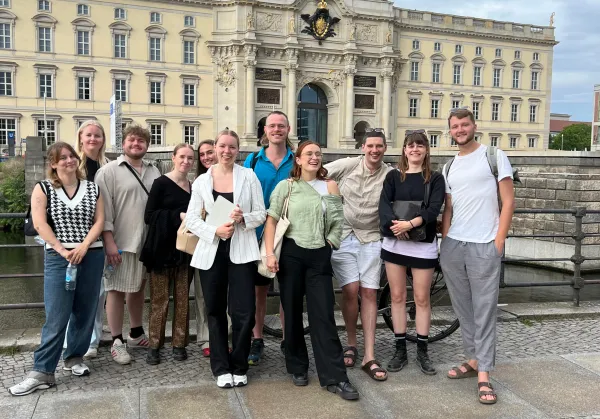
Students as Drivers of Education for Sustainability
In February 2025, students from Humboldt-Universität zu Berlin and Aarhus University came together for a joint workshop on organizational anthropology and sustainable transformation. The initiative aimed to combine international and interdisciplinary perspectives and apply anthropological approaches to real-world organizational challenges.
The collaboration was driven by the student led Sustainability Office and the tutorial project “Studying Transformation?!” at Humboldt-Universität, together with the course “Organizational Anthropology” at Aarhus. Online sessions prepared for a final in-person meeting at Aarhus University’s Copenhagen campus. There, the Berlin students led a peer-to-peer workshop exploring how universities within the Circle U. network can become more sustainable: Through collaborative analysis and project work, participants deepened their understanding of management, accountability, and sustainability, while also fostering intercultural exchange and long-term cooperation.
Following the successful Workshop in February, workshop participants from Humboldt-Universität and Aarhus University gathered again on 5 June (Circle U. Climate Day) at Humboldt-Universität with eight students to reflect on their projects and shared journey. In an open dialogue, they discussed successes, challenges and setbacks, while exploring strategies for future skill sharing, collaboration, and innovation in sustainability education across Circle U. universities.