From 2 to 3 July 2026, representatives from Circle U. took part in the European Universities Initiative: 2nd Research and Practice Symposium, hosted by WU Vienna University of Economics and Business in Vienna, Austria. Bringing together more than 90 researchers, practitioners, policy experts and government representatives, the symposium has become the leading annual forum for exchanging research findings, policy perspectives and practical experiences related to the European Universities Initiative (EUI), now comprising over 650 higher education institutions across 73 alliances.
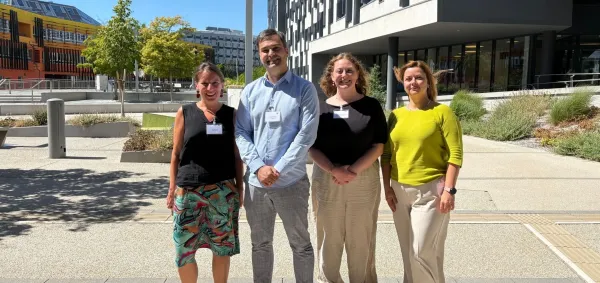
Circle U. was represented by Audrey Sullivan Reilly (Circle U. Office), Nikola Savić (University of Belgrade), Viki Menczel (University of Vienna), Bori Darabos (University of Vienna) and Kimberley Waechtler (University of Oslo).
Alongside the conference programme, participants also visited five Vienna universities belonging to different European University Alliances, gaining valuable insights into their governance models and implementation practices.
Driving the conversation on alliance impact and strategy
A highlight of the symposium was the participation of Audrey Sullivan-Reilly, Circle U.'s Monitoring, Evaluation and Learning (MEL) Officer, who was invited to join the expert panel "Defining and assessing the impact of European University Alliances – different perspectives." Bringing together researchers, academics, national agency representatives, independent strategy advisers and other specialists in impact assessment, the panel explored one of the most pressing questions facing the Initiative: how can alliances reconcile the European Commission's accountability framework, based on standardised key performance indicators, with the long-term institutional transformation they are expected to deliver?
The Circle U. MEL Officer addressed the question squarely:
“There is a need to recognise that these aren’t necessarily two different logics [KPI vs long-term institutional transformation], but rather, connected approaches that actually feed into one another. Reconciliation, I think, is about having a framework for alliances to measure both aspects in a meaningful way, over time. For Circle U., this is our MEL Strategy, which is an intentional approach we chose to ensure we have our own additional KPIs and outcome and impact indicators that are embedded in processes of reflection, accountability, and evidence-based decision-making, specifically for ourselves.”
The panel explored various views and approaches to what the future of impact assessment will look like if alliances are able to hold the authority over that assessment.
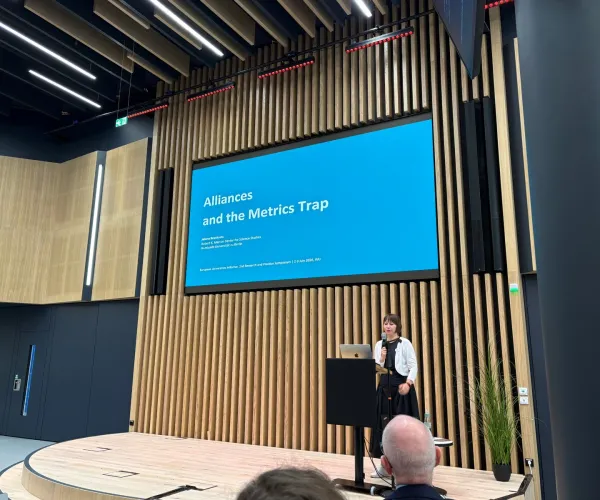
The symposium also featured a keynote address by Jelena Branković, Senior Researcher at the Robert K. Merton Center for Science Studies at Humboldt-Universität zu Berlin. In her keynote, "Alliances and the Metrics Trap", she explored the growing role of metrics in higher education governance and encouraged participants to critically reflect on how European University Alliances assess their performance and impact. Her presentation set the scene for many of the discussions that followed, highlighting the importance of balancing accountability with meaningful institutional transformation.
During the symposium, Kimberley Waechtler also presented "Projects or Projecting: Strategy and Organising in European University Alliances", contributing to discussions on how alliances are organised and strategically developed.
Researching institutional transformation across Europe
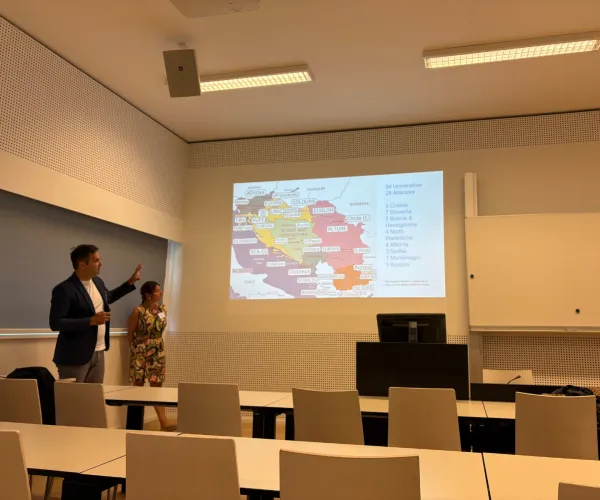
Circle U. also contributed to the symposium's research programme through the presentation of an ongoing study by Nikola Savić, Project Coordinator at the University of Belgrade, and Viki Menczel, Alliance Manager at the University of Vienna. Their research examines the potential impact of European University Alliances on the institutional transformation of universities in the Western Balkans. Rather than focusing exclusively on long-term systemic change, the study investigates more immediate and operational dimensions of institutional engagement with alliances. These include the extent to which different university structures participate in alliance activities, the integration of alliance objectives into institutional strategic documents, the perceived benefits of participation, cooperation with national authorities, and organisational adjustments resulting from alliance membership.
The research is based on a structured survey distributed to university leaders, alliance coordinators, academic staff and administrative personnel involved in alliance-related activities across the region. The presentation generated considerable interest among symposium participants and sparked a lively discussion on the particular challenges and opportunities faced by higher education institutions outside the European Union when engaging with the European Universities Initiative. By examining these often underexplored perspectives, the research contributes valuable evidence to the growing body of knowledge surrounding the Initiative and reinforces Circle U.'s commitment to evidence-based institutional development.
The symposium once again demonstrated the growing importance of research in shaping the future of the European Universities Initiative. Through both strategic discussions on impact assessment and the presentation of original research, Circle U. actively contributed to advancing knowledge and informing policy debates surrounding European University Alliances. The alliance's participation highlighted its commitment to continuous learning and evidence-based practice.