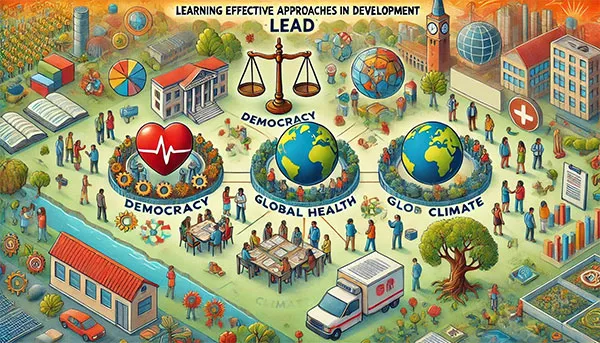
LEAD is led by Dan Banik, Professor of Political Science at the University of Oslo and Academic Director of the Circle U. Knowledge Hub on Democracy. The research team includes Jean Philippe Empana, Medical Doctor, Director of the Knowledge Hub on Global Health at Université Paris Cité, and Marcel Robischon, Professor of Agroecology, Director of the Knowledge Hub on Climate at Humboldt-Universität zu Berlin.
We've asked Dan to share some insights about his project and what his research team is aiming to achieve this year. Let's have a closer look at LEAD.
What is your project about?
The LEAD project is a collaborative initiative led by the Democracy, Global Health, and Climate Hubs of Circle U., with support from the Pasteur Network. It focuses on rethinking how success in development is defined, taught, and implemented. Rather than relying on abstract models, LEAD emphasises real-world practices that have made a measurable difference in the lives of marginalised communities.
The project will result in a new interdisciplinary, master's level course that explores effective strategies in addressing poverty, public health challenges, and environmental degradation. Central to the project is a co-creation process involving academics, students, and external partners, ensuring that the course reflects diverse perspectives and lived experiences. A planning workshop in early 2025 brought together key contributors to design the course collaboratively, including its structure, content, and delivery methods.
LEAD also aims to promote student engagement, intercultural dialogue, and critical thinking. Beyond the course itself, the project envisions long-term collaboration through publications and funding applications. By focusing on context-sensitive approaches to development, LEAD empowers students to contribute meaningfully to global challenges through evidence-based and inclusive solutions.
Why is this topic important?
Defining and achieving "success" in development is a critical yet often overlooked challenge. In a world facing persistent inequality, climate crisis, democratic backsliding, and global health emergencies, understanding what works - and why - is more important than ever.
The LEAD project addresses this need by shifting focus from abstract development goals to context-specific, evidence-based strategies that have shown real-world impact. It encourages critical analysis of both conventional and emerging approaches, taking into account power dynamics, local knowledge, and systemic barriers. The topic is especially timely in the current global context, where top-down, one-size-fits-all development models have frequently failed to deliver sustainable change.
By involving students, faculty, and external partners in co-creating knowledge, LEAD not only deepens academic inquiry but also fosters practical skills needed for future policymakers, researchers, and community leaders. It builds a learning ecosystem rooted in inclusion, intercultural dialogue, and hope — recognising that meaningful progress requires collective, informed action. This topic also aligns directly with Circle U.'s strategic themes — democracy, climate, and global health — making it essential to shaping the next generation of interdisciplinary leaders capable of driving change.
What are you aiming to achieve with this project over the year?
Over the coming year, the LEAD project will focus on co-developing a master's-level interdisciplinary course. It will blend interactive lectures, AI-enhanced learning, and case studies to explore success and failure across health, democracy, and climate.
The team also aims to produce at least one co-authored academic publication that shares insights from the LEAD initiative and its interdisciplinary methodology. Applications will be prepared for funding opportunities to support long-term sustainability. A post-course workshop will be held to evaluate the pilot, incorporating student feedback to improve future iterations.
Ultimately, LEAD aims to establish a scalable model of collaborative, impact-driven teaching that can grow into a full curriculum or doctoral training network, anchored in the Circle U. ecosystem. The project also seeks to build a lasting, transnational community of practice among students, faculty, and external partners.
Explain in which way your project has an interdisciplinary approach
The LEAD project adopts a deeply interdisciplinary approach by bringing together expertise from the fields of social sciences, humanities, public health, climate science, and political science. Complex global challenges such as poverty, inequality, public health crises, and climate change cannot be adequately addressed through a single disciplinary lens.
LEAD weaves together theoretical and practical knowledge from these varied domains to provide students with a more holistic and nuanced understanding of development. For example, public health perspectives are combined with insights from political science to assess the governance of health interventions, while environmental and economic frameworks are jointly used to evaluate climate-resilient poverty reduction strategies.
By integrating these multiple approaches, LEAD equips students with tools to analyse, compare, and improve development policies and interventions. This interdisciplinarity is not just reflected in the course content, but also in its teaching format - shared across three Circle U. hubs - and in the inclusion of diverse student and partner voices. It encourages critical thinking, cross-sectoral collaboration, and a systems-thinking mindset, essential for tackling interconnected global issues.