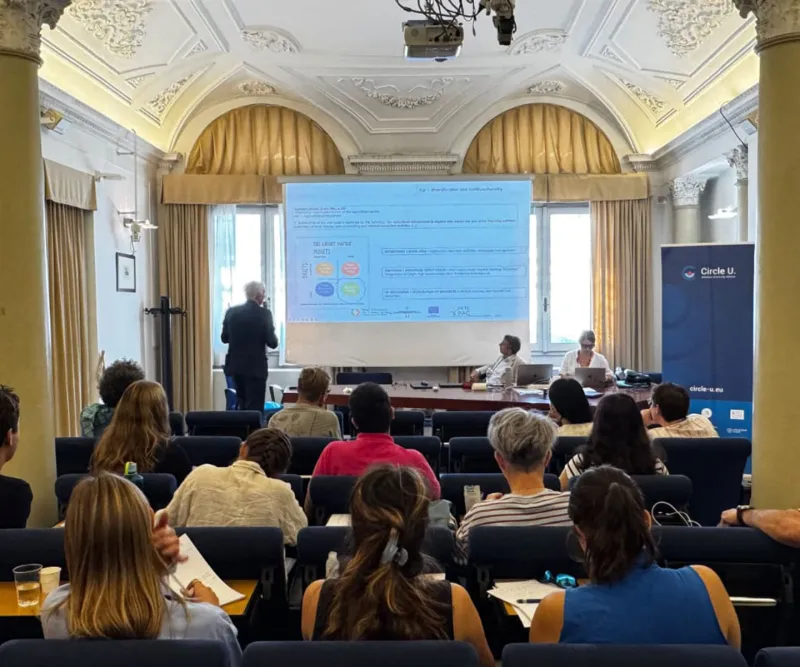
During this event, students step into the shoes of UN delegates, representing assigned Member States in committees, debating, negotiating, and seeking solutions to some of today’s most pressing global issues.

Why join through Circle U.?

By joining the Circle U. Delegation, students benefit from:

  • A unique international team experience, preparing and travelling together with peers from 9 European universities.
  • Exclusive training workshops (online, Autumn 2025–Winter 2026) led by experienced professors, MUN experts, and guest speakers.
  • Mentoring and support from faculty members throughout the process.
  • An opportunity to develop essential skills: public speaking, negotiation, teamwork, diplomacy, and intercultural collaboration.

Preparation & programme

Before the conference:

  • 6 online workshops (2 hours) on Microsoft Teams (20/10, 30/10, 13/11, 27/11/2025, 5/02, 19/02/2026).

In Rome:

  • Committee sessions, cultural and social events, city tour, expert-led workshops, and high-level guest lectures.

Who can apply?

  • Bachelor (excluding first-year students) and Master students with leadership skills, analytical ability, and team spirit
  • PhD students to serve as chairs and facilitators
  • Researchers to contribute expertise as guest speakers
  • Professors with MUN experience to lead and train student delegations

Want to know more about the experience?

Listen to the podcast from last year’s edition, featuring student testimonies and behind-the-scenes insights.

Practical info

These courses might interest you

MUN_Illustration-26-27
BachelorMasterPhD 2 ECTS

Circle U. Delegation to MUN Rome and MUN Paris 2027

Circle U. is bringing together a delegation of students from across four of its partner universities to take part in the MUN Rome 2027 Conference and MUN Paris 2027 Conference, two of the largest United Nations simulations in Europe.
Student at her laptop
PhD 0 ECTS

Generative AI in Teaching

This online course is designed for PhD students and university faculty members who wish to integrate generative AI into their teaching in a pedagogically sound, critical, and responsible way. The course combines theoretical foundations, practical demonstrations, and hands-on activities to help participants understand both the opportunities and the limitations of generative AI in higher education.
Circle U. Group of Students sitting in a park and looking at a laptop
BachelorMaster 3 ECTS

Lecture Series: Changing Cities, Changing Societies

How can cities become more sustainable, resilient, and climate-neutral? Changing Cities, Changing Societies brings together researchers, policymakers, and practitioners to explore how urban transformation can create meaningful and lasting change.
Circle U. Course LLMs and the future of writing - Two people working on a high-tech tool
MasterPhD 10 ECTS

LLMs and the Future of Writing

In this course, we not only cover past works from the likes of Foucault, Flusser, and others, but also contemporary work in AI Ethics, which address the impact of LLM assistance on the skills and capacities needed to write well – recent topics of how LLMs influence epistemic agency, critical thinking, and reasoning.
Students in Pisa
MasterPhD 0 ECTS

Rethinking Healthy Ageing: Bridging Care, Community, and Innovation

This three-day interdisciplinary workshop, taking place in Pisa from 21 to 23 October, explores one of the major societal challenges facing Europe: demographic ageing. Through expert talks, collaborative problem-solving, and innovation-focused activities, students will gain insights into the opportunities and challenges of promoting healthy ageing in increasingly ageing populations.
Sustainable Development Goals
Bachelor 5 ECTS

The Politics of Sustainable Development

This course will introduce you to the major theoretical and empirical approaches to the study of sustainable development, including the contested nature of the sustainable development discourse at global and national levels.

The alliance of 9 European Universities