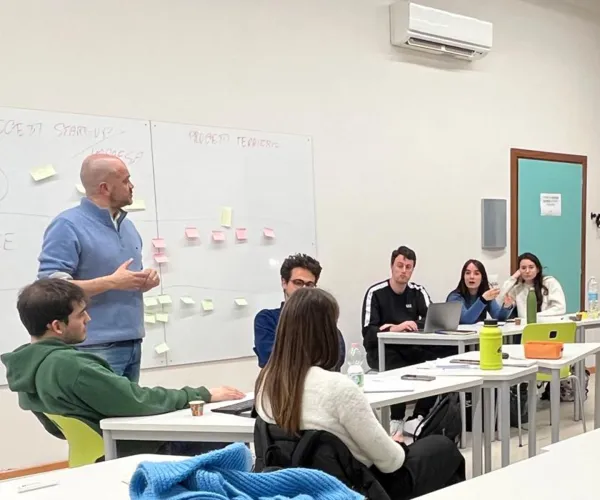
This thematic track – part of the INCLUDE webinar series – explores inclusion, equity, and diversity through the lens of innovation and entrepreneurship in higher education, focusing on team dynamics, communication, and participation in innovation-driven environments.
Alongside inclusive business incubation and ethical knowledge transfer, the track addresses neurodivergence and workplace bullying as factors shaping collaboration, leadership, and psychological safety.
At the end of the webinar series, participants who have attended at least 75% of the online sessions will be eligible to take part in an in-person Summer School to be held at the University of Pisa from the 6th to the 10th of July 2026.
Learning outcomes
Through topics such as inclusive pitching, allyship, and ethical communication, participants gain practical tools to foster accessible and inclusive innovation spaces where diversity drives creativity and social impact.
Who should attend
- Students interested in innovation, entrepreneurship, and socially driven projects
- Academic and administrative staff supporting innovation, start-up guidance, mobility, or entrepreneurial education
- InCU.bator participants and prospective applicants
- Facilitators, mentors, and trainers working with diverse and interdisciplinary teams
- Anyone in the Circle U. ecosystem seeking to strengthen competencies in inclusive leadership, allyship, intercultural communication, and the prevention of exclusionary and harmful dynamics in innovation environments
Additional information
Participants will be awarded:
- Micro-credentials will be recognised for attending the webinars
- 5 ECTS: For attending the final Summer School
Digital seminars
Webinar for all.
Inclusion, along with diversity and equity, is one of the key words of the present, and represents the efforts of a society that, aware of its structural injustices, seeks to overcome them in the direction of greater social and cultural justice. Beyond cultural and political circumstances that are not always favorable to inclusion movements, the time has come to recognize the limits of this perspective, which continues to divide society's members into those who are normal and those who are different (thus "abnormal"), with the idea that the former have the role of including the latter. Is it possible to imagine another kind of society, one in which differences are not to be included, but in which people, recognizing their mutual differences, can attempt to coexist?
Webinar for students
The webinar will offer an evidence‑based overview of workplace bullying, examining its prevalence, defining features, early warning signs and underlying organisational and individual drivers. It explains how bullying evolves from conflict into long‑term harmful behaviour, outlines its severe consequences for targets, teams and organisations, and highlights the challenges of recognising and measuring negative acts. Drawing on international research, it discusses why bullying persists despite decades of interventions and presents practical, multi‑level prevention and response strategies for organisations, managers, bystanders and targets. The session concludes with a case study to help participants apply concepts to real‑world organisational dynamics.
Webinar for all.
Most entrepreneurship support programs are designed for a narrow type of founder, which results in leaving many ideas and people behind. In this webinar, we will explore what it means to create business incubation systems that support diverse backgrounds and needs. Through interactive exercise, we’ll step into the shoes of different entrepreneurs to understand their challenges and the support they need. We hope this webinar inspires new perspectives and concrete approaches to making entrepreneurship accessible and supportive for the 99% of founders who are often left out.
Webinar for staff.
This webinar provides an evidence-based overview of workplace bullying, with a specific focus on higher education settings. It explores how academic hierarchies, power asymmetries and organisational cultures can enable bullying to emerge and persist within universities. The session examines early warning signs, challenges in recognition and reporting, and the individual and institutional consequences of prolonged harmful behaviours. Drawing on international research, it discusses why bullying remains difficult to address in higher education despite formal policies, and presents practical, multi-level prevention and response strategies tailored to academic and administrative staff. The webinar concludes with a case study grounded in real-world higher education contexts.
Webinar for students.
This student-led webinar explores neurodiversity and neuroinclusion in higher education through lived experience. Drawing on the Diverse Brains, Inclusive Education Moodle course co-created with neurodivergent students, the session examines how everyday study practices, peer interactions, group work, and institutional norms can unintentionally disadvantage neurodivergent learners. Through scenario-based discussion, participants will reflect on their roles within learning communities and consider practical ways to foster more inclusive, supportive, and neuroinclusive academic cultures.
Webinar for staff.
This interactive webinar explores neurodiversity and neuroinclusion in higher education through research-informed practice and lived experience. Drawing on the Diverse Brains, Inclusive Education courses co-created with neurodivergent staff and students at King’s College London and the University of Warwick, the session examines how teaching practices, assessment, peer interactions, and institutional cultures can unintentionally exclude neurodivergent individuals. Participants will work through real-life scenarios and reflect on inclusive responses, shared responsibility, and practical strategies to foster neuroinclusive learning and working environments.
Webinar for staff.
This webinar explores neurodivergence, Reasonable Accommodation, and Universal Design for Learning (UDL) as core principles for inclusive and accessible university teaching. Shifting from a reactive, individualised response to an ex ante planning approach, it argues that inclusion should be embedded in course design from the outset. Drawing on pedagogical research and the Inclusive Teaching UNIPI project, the session illustrates how flexible learning environments, multiple modes of engagement, and diverse assessment strategies enhance learning quality for all students, while promoting equity, accessibility, and democratic participation in higher education.
Webinar for all.
The webinar focuses on how to craft and deliver pitches that are inclusive, accessible, and culturally aware. Going beyond presentation skills, it explores how narrative choices, language, visuals, and framing can either widen or limit participation. Particular attention is given to pitching from positions that fall outside dominant entrepreneurial norms, whether related to gender, cultural background, professional trajectory, or social positioning. Participants will practise strategies for presenting ideas in ways that resonate across cultures and identities—both when pitching themselves and when mentoring students or supporting early-stage innovators.
Registration
- Sunday, March 29 (for the Keynote Speech)
- Sunday, April 12 (for the webinars)
Summer School in Pisa
Participants who have attended at least 75% of the online sessions will be eligible to take part in an in-person Summer School to be held at the University of Pisa from the 6th to the 10th of July 2026. The Summer School will represent the final component of the programme and is intended to consolidate and further develop the knowledge acquired during the webinars, ensuring continuity and a shared academic foundation among participants.
For students:
Find out more about the Summer School here (info and registration form).
For staff:
Find out more about the Summer School here (info and registration form).
Contact
For any questions regarding the course content, structure, participation, or general organisation, please contact Alessandra Meoni (alessandra.meoni@unipi.it).
For questions related to funding, ECTS recognition and mobility, please contact the Circle U. office at your home university:
-
Aarhus University: aarhus@circle-u.eu
-
University of Belgrade: Nikola Savić – nikola.savic@rect.bg.ac.rs
-
Humboldt-Universität zu Berlin: berlin@circle-u.eu
-
King’s College London: circle-u@kcl.ac.uk (Erasmus+ funding not available; internal funding may apply)
-
UCLouvain: infocircleu@uclouvain.be
-
University of Oslo: oslo@circle-u.eu
-
Université Paris Cité: circleu.iro@u-paris.fr
-
University of Pisa: circleU.erasmus@unipi.it
-
University of Vienna: circle-u@univie.ac.at