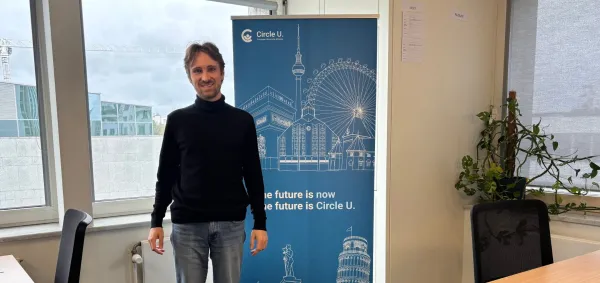
With a background in political science and a keen interest in international politics and the European project, Henri is joining Circle U. with a personal appreciation of the value of cooperation between European universities. As he begins his work with the alliance, we asked him a few questions about his journey, motivations, and ambitions.
Could you tell us a bit about yourself and your background?
I studied political science in Hannover, Paris, and Vienna. I have always been drawn to analytical thinking and have had a strong interest in global politics. Studying political science allowed me to systematically learn how the world works and how democratic institutions guide us through the modern era. I was particularly interested in how political institutions function, drawing on sociological theories and methods.
For my master’s thesis, I explored the electoral success of populist radical right parties, focusing on how they establish themselves as competent on specific political issues. Given their success, following the news or scrolling through social media can sometimes give the impression that populist radical right parties are an unstoppable, almost mythical force. My interest was to look beyond that perception and examine the concrete mechanisms that have enabled these parties to succeed in recent elections. I also believe that understanding the specific dynamics can offer valuable lessons for democratic forces.
What inspired you to apply for an internship at Circle U.?
Having studied in three European countries myself, I have benefited a lot from the cooperation of European universities. Everywhere, but especially in my field of study, it is inspiring to leave your own environment and get to know other perspectives. Circle U. plays a key role in making this exchange possible for students, researchers, and universities. Contributing to enhancing cooperation while improving my skills in the areas of Monitoring, Evaluation & Learning (MEL) and policy analysis was my main motivation. Besides that, with my background, it is naturally exciting to get to know political life here in Brussels and look behind the scenes of EU politics.
What are your main responsibilities, and what will you be working on during your internship?
As MEL & Policy Assistant, I am responsible for the statistical analysis of the MEL databases from recent years and current projects. I clean up and prepare the datasets and contribute to collecting the data from the current projects. On the policy side, I would describe my task as scanning the European environment for trending topics and emerging opportunities for CU and its partners.
What are you most looking forward to learning or developing during your internship?
The internship is a great opportunity to strengthen my organisational skills and develop my communication skills in a professional environment. During your studies, you tend to focus on the theoretical and analytical side of research and politics. Practical aspects, such as organisational processes, communication in international settings and the day-to-day realities of professional work, are things you often learn by doing. I see this internship as a great opportunity to gain that practical experience.
What are your career aspirations, and how do you see this internship helping you achieve them?
The internship helps me to orient myself in the professional world of Brussels and international politics. I would like to work in this field because I think the European project and international cooperation have become more important than ever. I am concerned about the growing tendency towards a more ‘every country for itself’ approach. I believe there is still considerable potential in international political cooperation. In Germany, for example, 90% of the people speak out in favour of staying in the EU, while only 52% say that they trust the EU in its concrete institutional form. Political scientists might point out that this is a relatively high level of trust compared with other institutions. Nevertheless, I believe there is room for improvement, and I would like to make my own modest contribution.
Now that you’ve had your first month at Circle U., has anything surprised you or stood out to you?
I did not expect how interconnected the whole field is. It is exciting to see how closely the alliance partners work together, not only with one another but also with other alliances and EU organisations here in Brussels. I have already met so many people in person and online that I have trouble remembering everyone’s name!
Outside of work and your studies, what do you enjoy doing in your free time?
Even though I do not have TikTok, the sourdough trend has definitely taken over my free time. There is this scene in Ratatouille where one cook explains to Remy what makes good bread. I can relate to that.
Besides that, I love playing football. I have been playing since childhood, and it is a great way to switch off, clear my mind, and enjoy the moment. It is also helpful to meet new people and practice my French here in Brussels.
Can you share a fun fact about yourself that your colleagues might not know yet?
I enjoy classical literature and exploring settings and places associated with it. There were plenty of interesting places to visit in Paris and Vienna. I feel that visiting the settings can give you a completely new understanding of the stories and authors. To be honest, I have not read that much of Belgian literature so far, so I cannot really say if that also accounts for Brussels, but I will definitely explore over the coming months. In case someone is planning a trip, I can recommend visiting the Strudelhofstiege in Vienna or the Ödön von Horváth memorial stone on the Champs-Élysse.
Welcome to the Circle U. team!
We're delighted to have Henri with us at the Circle U. office in Brussels, and we look forward to seeing how he'll contribute to the team over the coming months.
We hope his time here will bring plenty of opportunities to learn, exchange ideas and explore his interest in European cooperation. Welcome to the team, Henri!