There was a time when, to mark the beginning of their university life, first-year students at the University of Pisa would go to “Fiaschi”, a hat shop on Corso Italia, to buy their academic feluca. Today, “Fiaschi” has closed, but the memory of that ritual lives on.
What is the feluca?
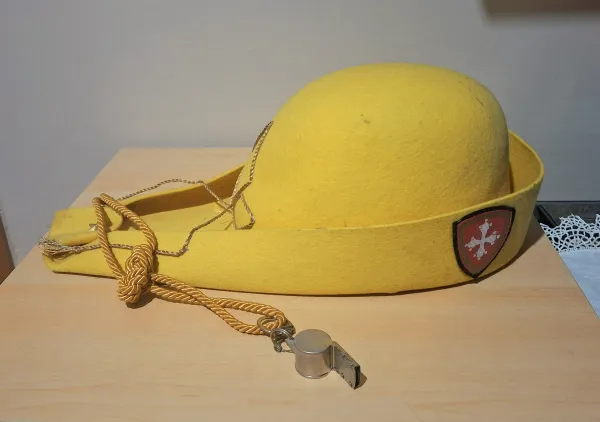
The feluca was a type of headgear commonly worn in everyday dress during the fourteenth and fifteenth centuries. Over time, it disappeared from ordinary use, but survived thanks to student tradition, becoming a symbol of Italian goliardia (student traditions and rituals) from the late nineteenth century.
The name derives from its pointed shape, reminiscent of the Ottoman felucca. It is precisely this tip that makes the Pisa student tradition unique.
Tip-cutting
On 29 May 1848, the Battle of Curtatone and Montanara took place, a key event in the Italian Risorgimento. The Tuscan University Battalion, composed of 389 students and 66 professors from the University of Pisa, volunteered to fight in the First War of Independence. Many lost their lives, but their sacrifice helped pave the way for the Piedmontese victory at Goito shortly afterwards.
According to tradition, during the battle, the students cut the tips of their felucas to aim their rifles more easily.
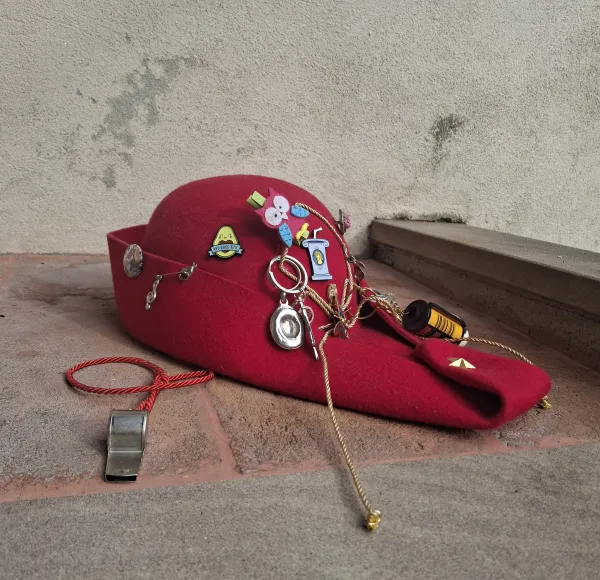
From that moment on, the feluca without its tip became a mark of identity. Every 5 November (the opening day of the academic year), first-year students at the University of Pisa take part in the ritual of the tip-cutting, either cutting or folding the point of their hat.
Colours and pins
The colour of the felt is not random: each faculty has its own, derived from the robes and headgear worn by students and professors in the Middle Ages.
- White – Humanities, Philosophy, Theology, Languages
- Red – Medicine
- Green – Natural Sciences, Mathematics
- Blue – Law
- Black – Engineering, Architecture
- Yellow – Economics
- Orange – Sociology
- Pink – Education
- Grey – Psychology
- Light blue – Fine Arts
- Purple – Political Science
Colour is not the only distinguishing feature: for each exam passed, students attach a pin to their hat representing the subject studied.
Student headgear abroad
The tradition of student headwear is not unique to Pisa. Similar customs exist in other European universities. At UCLouvain, for instance, there is the calotte.
“It is a small, round cap with a flat top,” says Carla, a student ambassador at UCLouvain. “It is a symbol of student identity and is mainly worn during traditional events. Students attach pins to it to mark their achievements. Receiving the calotte is like being crowned: it is awarded by the Grand Maître after an initiation ritual.”
The calotte first spread in Louvain — where the top (calot) is burgundy — and later in Liège (green) and Ghent (white). Today, it serves as a kind of student identity card: a symbol of belonging to an organisation, a community and a tradition, but also of adherence to values such as respect, tolerance and openness.
The goliardic tradition
The “Fiaschi” shop has closed, and fashions have changed, but some independent groups of Pisa students still strive to preserve university traditions. These are the so-called Goliardi Pisani, who, with limited resources but great passion, keep alive and promote a custom that might otherwise have disappeared.
Their activity is not merely folkloric. In a city like Pisa, where the university is an integral part of the urban fabric, preserving these traditions means keeping alive the character of the institution — an institution that for centuries has helped shape the identity of the region, in Pisa as in the other universities of the Circle U. alliance.
In this sense, valuing traditions means recognising that the university is not only a place of study, but also an actor that contributes to shaping the city and its collective memory.
Keeping the memory of these rituals alive is not only enjoyable but also important: traditions belong to everyone, and sharing them is a simple yet meaningful way to feel part of a community that endures over time.