"The University Cannot Remain Silent" — A Conversation with Two Serbian Academics
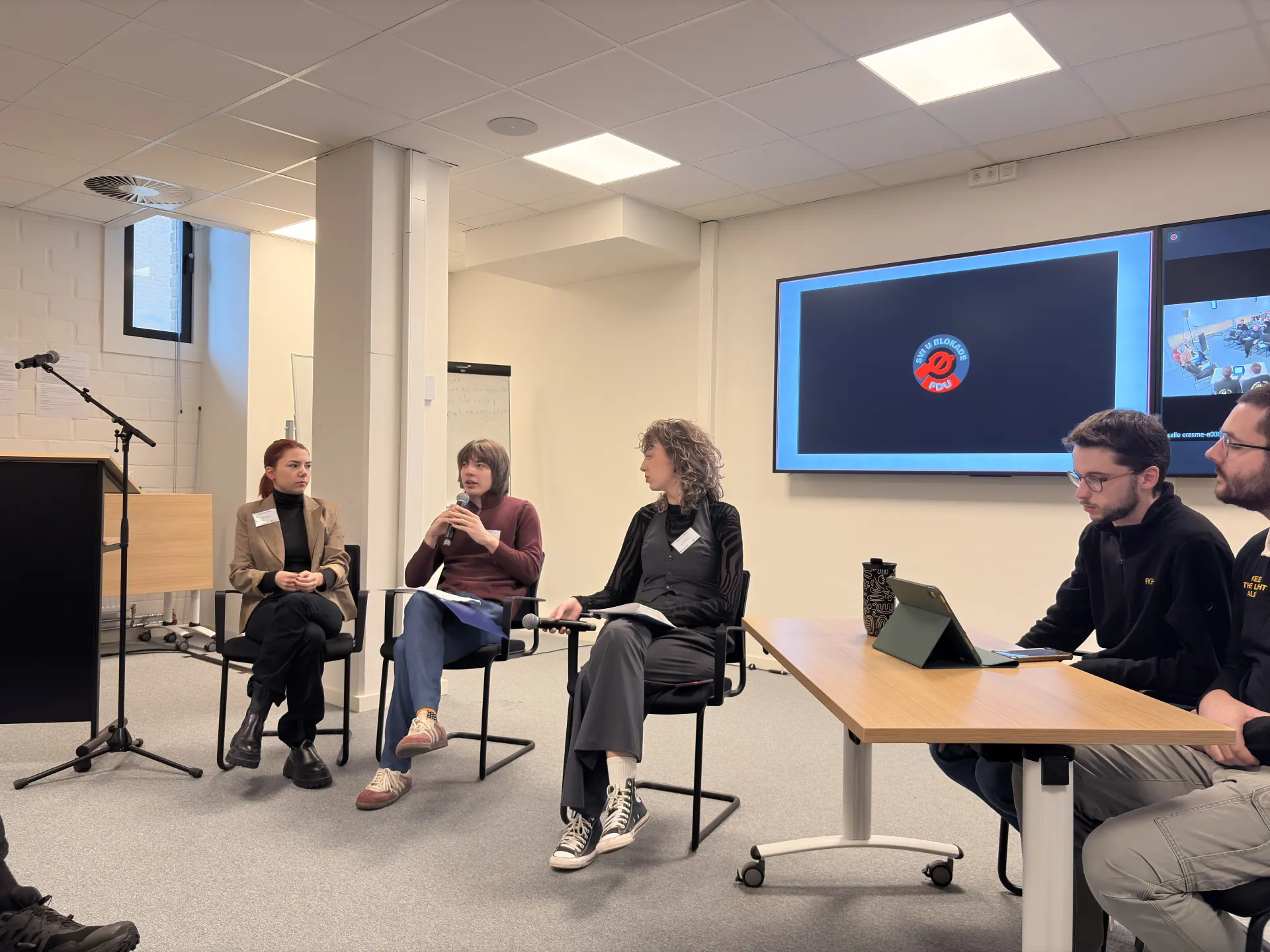
On 12 and 13 March 2026, UCLouvain hosted Agents of Change (Serbian) Students and Universities in Struggle for Academic Freedom, University Autonomy and Democracy, an event bringing together Serbian students and academics to discuss the struggle for academic freedom, university autonomy, and democratic values in Serbia. The event was organised by Jonathan Chatel (INCAL, UCLouvain) and Goran Petrović Lotina (UCLouvain, and former student at the University of Belgrade), framed within the Circle U. alliance, of which the University of Belgrade is a member.
The current wave of student mobilisation in Serbia was triggered by the collapse of a canopy at the Novi Sad railway station on 1 November 2024, which killed 16 people. The disaster rapidly became a symbol of institutional failure, corruption, and impunity — and sparked a nationwide protest movement that has since grown far beyond its initial demands.
Among the guests were Vanja Bajović, Professor of Criminal Procedure, and Radina Vučetić, Full Professor of Contemporary History and Head of the Center for American Studies at the Faculty of Philosophy, University of Belgrade. We invited them to reflect on the movement, its stakes, and the meaning of European academic solidarity
The student movement emerged after the tragedy of 1 November 2024 in Novi Sad. How did this moment transform your relationship to the university, to justice, and to public responsibility?
Vanja Bajović — The tragedy strengthened my awareness that the university is not merely a place of knowledge transmission, but also a space of public responsibility. In times of profound social crisis, university professors have a duty to speak publicly and to contribute to a more informed public understanding. Our role is not to replace political actors, but to help society reflect more clearly on what is happening and why it matters.
Radina Vučetić — For me, this moment redefined the core pillars of my professional and civic identity. The university reclaimed its role as a polis — a site where resistance is articulated and where theories of ethics and human rights are transformed into active support for students. I belong to the Faculty of Philosophy in Belgrade, an institution that served as a cradle of resistance during the 1968 movement and the student protests of the 1990s against the Milošević regime. That legacy is not just a matter of prestige — it is a continuous obligation to stand with our students in their fight for justice.
The movement's demands have evolved significantly. What are the current priority objectives?
V.B. — What began with calls for transparency and accountability has evolved toward a focus on strengthening independent and impartial institutions capable of overseeing any government. The struggle for functioning institutions is a long-term process — and it does not end with a change of government. It continues through educating citizens and building a democratic culture in which society learns to hold every authority accountable.
R.V. — Our priorities have shifted toward survival and fundamental democratic defense. We are moving beyond local grievances toward a broader political battle. The objective is no longer just local reform, but a determined attempt to prevent the complete erasure of democratic values — and to ensure that the world does not look away while a European society is being systematically silenced.
How does the current situation affect university autonomy and the role of professors?
V.B. — Governments with more centralised or authoritarian tendencies show limited tolerance for truly autonomous universities, precisely because universities cultivate critical thinking and independent judgment. Our responsibility is to defend the space for free thought and academic integrity.
R.V. — University autonomy is under systematic assault — not through overt censorship, but through salary cuts, interference in scientific work, and the withholding of research funding. Professors and young researchers face a tragic choice: stay and be silenced, or leave and continue your work elsewhere. This brain drain is not a side effect — it is a tool of political pacification.
The University of Belgrade is a member of Circle U. How can this European alliance strengthen your action?
V.B. — Participation in European university networks reminds us that we are part of a broader academic community grounded in shared values — academic freedom, critical thinking, and social responsibility. In times of crisis, international cooperation helps prevent isolation and creates opportunities for our experiences to be heard.
R.V. — These platforms represent far more than routine academic cooperation. They provide a vital space for visibility at a time when local channels are being systematically choked. By giving us visibility, Circle U. helps prevent our struggle from being buried in silence — reminding the global academic community that the defense of academic and civic values in Serbia is a shared European responsibility.
What are your expectations from the European academic community?
V.B. — We do not expect Europe to solve our internal challenges. But students today are defending the very foundations of the European political and legal tradition — the idea that all citizens are equal before the law and that those who exercise power must remain accountable. I hope the European academic space will continue to offer support and visibility to those who seek to uphold these principles.
R.V. — My expectation is that students and academics worldwide follow the example set in Belgrade, Novi Sad, and across Serbia. We are not just fighting for our own local rights — we are offering a lesson in resilience that the entire democratic world desperately needs to remember.
Reflections of a UCLouvain student
Among the attendees was Ariana, a UCLouvain student and Student Fellow at the Circle U. Knowledge Hub Democracy, who reflected on what the seminar stirred in her.
"Taking part in the seminar meant, on one hand, feeling the guilt of inaction in a world full of injustices, and on the other, admiring the courage with which Serbian students mobilise for their ideals.
Professor Vučetić expressed a kind of surprise that young people are still capable of rallying behind a cause. The three students who took part in the first panel are living proof of this, each bringing their own experiences and challenges. For instance, being a woman means navigating vulnerability differently when faced with the violence of those who seek to suppress the winds of change."
This seminar showed me just how diverse the academic world — professors and students alike — truly is, and how it is not always aligned, as reflected in the sometimes provocative reactions from the audience. Ultimately, disagreement turns out to be one of the most powerful expressions of academic freedom we can experience.

Ariana, student at UCLouvain
The Agents of Change event was organised at UCLouvain on 12 and 13 March 2026, by Pr Jonathan Chatel (INCAL, UCLouvain) and Pr Goran Petrović Lotina (UCLouvain, and former student at the University of Belgrade), with the support of the Rector of UCLouvain, Professor Françoise Smets, and of Circle U. team at UCLouvain, and in coordination with Professor Isabelle Aujoulat, Vice-Rector for Equity, Diversity and Inclusion, and Professor Hervé Jeanmart, Pro-Rector for International Affairs, and the Centre for Theatre Studies (Centre d’études théâtrales, CET). The University of Belgrade is one of nine members of the Circle U. European university alliance.