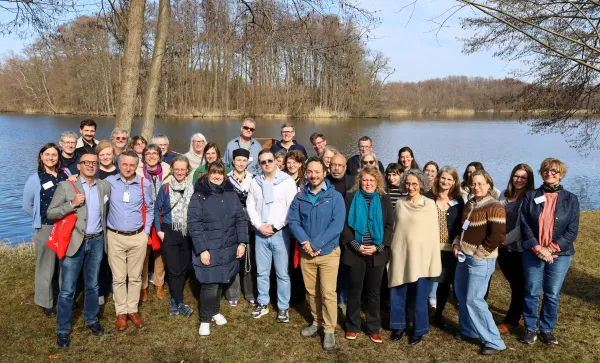
Internally, Circle U.'s Academic Chairs are routinely referred to as the alliance's backbone: They link research and teaching across member universities and play a central role in delivering learning opportunities on the Open Campus. As Circle U. expands into new academic fields and continues to grow its course catalogue and event calendar, the number of Academic Chairs has risen from 49 in autumn 2023 to 74 (plus 6 Academic Directors) to date. Over the last 12 months alone, 15 more academics have joined the programme.
Vinicius de Carvalho, Circle U.’s Vice-Dean for Academic Chairs, explains why this growing community is essential to the alliance’s success:
"We have a highly diverse network of universities and academic traditions across the alliance, and the Academic Chairs programme fosters a sense of community that is vital to Circle U.’s stability."

Vinicius de Carvalho, Vice-Dean for Academic Chairs
As a facilitator of dialogue between the academics themselves and with governance, he has seen the programme evolve into a key driver of the alliance's development: "Many of the offers on the Open Campus are led by the Chairs, which shows how much we are achieving."

A packed programme in the Brandenburg countryside
The growing number of involved academics and activities requires strong coordination and collaboration. For this reason, from 18 to 20 March 2026, 28 Chairs and 14 administrative colleagues came together for an intensive retreat at a lakeside seminar venue in Eggersdorf, east of Berlin. A further 17 joined online.
The packed programme covered both the opportunities and challenges of tools such as Erasmus+ Blended Intensive Programmes, as well as the planning and delivery of joint online and hybrid courses. Participants also explored funding opportunities and support structures, discussed how to strengthen collaboration across platforms and faculties, and reflected on the future direction of Circle U.
As Isabelle Mensching, Climate Hub Coordinator and member of the Berlin team, explains:
"For many, this retreat serves as a kind of onboarding – an opportunity to get to know colleagues and some of the resources they have access to. At the same time, we address the challenges we encounter and share solutions we have already identified."

Isabelle Mensching, Climate Hub Coordinator

The Chairs’ takeaways
One of the professors benefiting from this extended onboarding was Jean-François Rees from UCLouvain, who joined the Circle U. Teaching Innovation Lab (CU.til) in September to connect with a wider network of like-minded innovators: "I am Belgian, I come from a tiny country, and I always felt it was important to be in contact with people around Europe. So, this European feeling is very nourishing." So far, he has organised a workshop with a colleague from Vienna on making laboratories more environmentally sustainable and has connected with fellow academics to test new pedagogical tools he has been developing at UCLouvain.
His CU.til colleague Christina Richardson from King’s College London has contributed to a webinar series and a prospective summer school on equity, diversity, and inclusion. She highlights the value of international exposure for students and notes that a workshop on Collaborative Online International Learning (COIL) in particular has inspired new ideas for creating more seamless learning experiences.
Overall, participants left with a stronger sense of community, a clearer understanding of available opportunities, and renewed motivation for the months ahead. As Ute Smit, Academic Chair with the Multilingualism and Interculturality Lab (CU.mil) and contributor to its Language Compass, puts it:
“It is inspiring to work with people from different fields who share a passion for innovative teaching. From a teacher’s perspective, collaborating and learning to question one’s own approaches is a valuable opportunity.”