Why this matters
Language and intercultural competences remain undervalued in many labour markets, despite their growing relevance in globalised, multicultural work environments. Many students struggle to explain what their language skills are actually worth to an employer, while academic curricula often fail to make the connection between language learning and employability explicit — even as employers increasingly look for graduates who combine disciplinary expertise with intercultural competence, adaptability and a global outlook.
From Campus to Career addresses this gap. First introduced in February 2025 as a Circle U. seed-funded project, it has since been developed by a consortium of five Circle U. partner universities, through a co-creation process led and coordinated by Dr Ana Kanareva-Dimitrovska (Aarhus University), with contributions from colleagues across the alliance. The two tools envisioned at the outset are now available.
A research-based approach
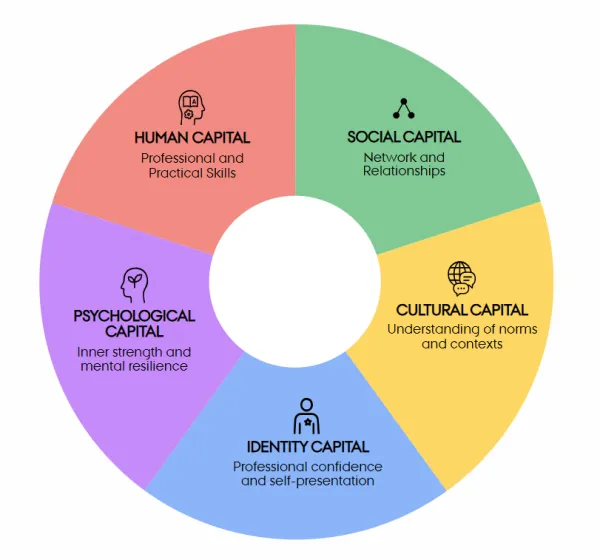
The project draws on the Graduate Capital Model developed by Michael Tomlinson (University of Southampton, 2017), which frames employability not as a fixed set of technical skills, but as five interconnected forms of capital that students build throughout their studies: human, social, cultural, identity and psychological capital.
Applied to language learning, this framework makes visible what students often overlook in themselves:
- Negotiating common ground. Reformulating a point of view to find shared understanding is a reflex trained every time a student moves between languages.
- Adapting without losing oneself. Most people are not quite the same person in every language they speak. They are more direct in one, more cautious in another. This ability to adjust, known as code-switching, is a genuine asset in job interviews.
- Building bridges. Inviting someone to express themselves in their own language, then rephrasing for the wider group, opens access to networks, and sometimes to career paths students had not considered, from intercultural mediation to international project coordination.
- Bouncing back. Making mistakes in public, repeatedly, and carrying on regardless builds a resilience that extends well beyond language learning, into interviews, public speaking and professional setbacks.
Two tools, freely available
To help students put these skills into words, the project offers two complementary resources:
- The Employability Skills Mapping Tool (ESMT), a framework that helps students, staff and career service professionals identify and communicate the skills and capitals embedded in language education.
- The Employability for Languages Module (ELM), an online learning module covering five themes of around 20 minutes each, designed to be completed independently, in groups, or together with a career adviser.
Both tools are relevant well beyond language students: international students, alumni considering a career change, and anyone who has been through a period of mobility can draw on them to better articulate this often-invisible part of their profile.
For students
Students across Circle U. partner universities can explore the mapping tool and the online modules to better understand how their language skills translate into professional strengths and start building the vocabulary to make that case with confidence.
Discover the tools
From Campus to Career is a Circle U. project, co-created by researchers and language educators across partner universities, including Aarhus University, King's College London, Humboldt-Universität zu Berlin,University of Oslo, and UCLouvain.
The content of the Employability Skills Mapping Tool (ESMT) and the Online Employability for Languages Module (ELM) has been developed through a co-creation process involving contributions from colleagues across partner institutions Dr. Ann Carroll-Bøgh, Dr. Ana Maria Sousa Aguiar de Medeiros, Dr. Catherine Jaeger, Carla el Khoury, Karen Lintner, Dr. Katherine Opello, Morag Walling, Torunn Nyland, Ludmilla Aufurth, led and coordinated by Dr. Ana Kanareva-Dimitrovska.