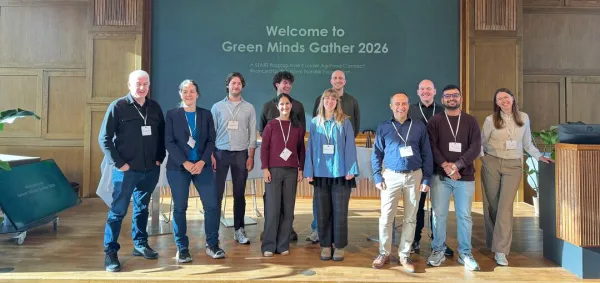
Prof. Polymeros Chrysochou (Department of Management, Aarhus BSS, Aarhus University) and Prof. Derek Victor Byrne (Department of Food Science, Aarhus University) coordinated the course. It brought together 12 PhD students and early career researchers in fields from food science and engineering to genetics, management and business. Participants came from Aarhus University, the University of Southern Denmark and Copenhagen Business School. Two came from Circle U. partner universities: Alex Häuser (Humboldt-Universität zu Berlin) and Riccardo Negro (University of Pisa).
Three sessions, one project
The course ran over three two-day sessions. The first two were in Aarhus, and the last was in Copenhagen. Participants formed interdisciplinary groups and developed research project ideas from the first brainstorm in August to final presentations. Along the way, they heard from experts in food systems transformation, sustainable diets and health, primary production, environmental impact assessment, co-creation, project management and mission-driven research funding. One of these was Prof. Alessio Cavicchi from the University of Pisa, who spoke on co-creation as a driver for interdisciplinary research in food systems and rural areas.
What the groups came up with
One group (Himan Kalita, Alex Häuser, Geraldine Vásquez, Riccardo Negro, Emma Cecilie Sørensen and Mac Krol) developed INSECT-URBAN, a project on how insect-based foods could move from a niche product to an ordinary option in European cities. Their starting point was that turning insects into food is no longer the hard part. Getting people to buy them routinely is, and that depends on price, availability, regulation and business models as much as on consumer acceptance. The group proposed combining food science, consumer research, market and policy analysis and environmental assessment to compare transition scenarios, with producers, retailers, city authorities and consumers helping to judge which scenarios are realistic. The goal they set was a modest one: insects as a recognised and affordable part of the protein mix, without replacing meat. They also designed the approach so that it could be applied to other new foods that struggle to get beyond a niche.
The other group (Celeste Maffezzoni, Mathias Frydensberg Sørensen, Kasper Schmidt Krongaard, Irina E.A. Costin and Laura Vemmelund Jørgensen) developed SUSFOOD, a project on helping people who want to eat less meat to actually do so. Danish adults eat more than twice the amount of meat the official dietary guidelines recommend, and many say they want to cut down, but limited cooking skills and family routines get in the way. The group proposed a website and app, piloted in Denmark, that brings together expert-validated plant-rich recipes, short videos on techniques such as cooking tofu or fermenting at home, information on the health and climate impact of ingredients, and a community where users share meals and can ask experts. Consumers, chefs and experts would co-design the platform, and a pilot with at least 200 users would track whether users’ cooking confidence and meat intake change. If the Danish pilot works, the platform could be adapted to other European countries.
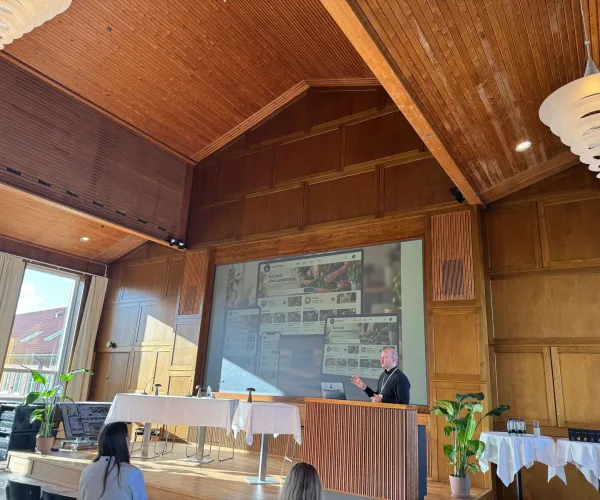
The course ended with the students presenting their projects at the Green Minds Gather 2026 conference in Copenhagen, which put their ideas in front of an audience beyond the course.
What participants took away
For Alex Häuser (Humboldt-Universität zu Berlin), the main lesson was about what it takes to move from sustainability goals to practice:
“Coming from an environmental systems perspective, the course was a valuable opportunity to explore what it actually takes to translate sustainability ambitions into practice. Working with researchers from different disciplines challenged me to think beyond environmental goals and consider the technological, economic and social realities of bringing new food solutions into everyday life. Together with the discussions at the Green Minds Gather conference, it reinforced how important it is to connect ambitious visions for food systems transformation with realistic pathways for change.”
Riccardo Negro (University of Pisa) pointed to the people he met:
“I am very glad to have participated in the course on ‘Sustainable Food Systems and Interdisciplinary Research Practices’, where I had the opportunity to engage with and build connections with many people from diverse cultural and professional backgrounds.”
The course was supported by START | Centre for Sustainable Agrifood Systems, the CiFOOD Cluster, the MAPP Centre and Circle U.