European university alliances featured prominently throughout the conference, with dedicated sessions, poster presentations, and stands in the exhibition area. Circle U. contributed to this discussion from several perspectives, sharing experiences and examples of how collaboration across universities can support people and ideas, measure progress, and build the foundations for long-term sustainability.
Supporting female innovators across Circle U.
One way alliances can create lasting change is by creating opportunities for people and ideas that might otherwise struggle to find a platform. Entrepreneurship in Europe faces a striking gender gap. Only one-third of EU start-ups are led by women, and young women innovators, particularly students, remain underrepresented. Since diverse perspectives are essential to addressing contemporary challenges, this gap limits opportunities and stifles innovation. The Circle U. Women Founders Network was established to help address this imbalance.

Setayesh Karami, a member of the Circle U. initiative BeeLead, presented the group's work to support and empower female innovators across the alliance. Through mentorship, networking opportunities, community building, and entrepreneurial training, BeeLead aims to equip young women with the skills and confidence needed to pursue their ideas and take on leadership roles as founders and changemakers.
As a Community Organiser in BeeLead, Karami emphasised the importance of creating spaces where aspiring entrepreneurs can learn from one another and build lasting connections:
"We are a student-led initiative that builds an inclusive and supportive community where young women can connect, exchange ideas, and gain the knowledge and skills needed to thrive as entrepreneurs."
Her poster traced the development of the initiative across the Circle U. alliance, from the Female Founders Retreat in Paris, where students and academics came together to create a shared manifesto, to events in Pisa and Aarhus focused on networking, community building, and entrepreneurial projects. It also highlighted the most recent gathering in Louvain-la-Neuve, where female students and early-career researchers collaborated on real-world challenges related to mental health, well-being, social innovation, and education.
Together, these activities illustrate how collaboration across universities can create the conditions for new ideas to emerge and grow. But for alliances to demonstrate that their work is making a difference, they also need ways to understand, measure, and learn from the changes they are creating.
From activities to long-term impact
As many European university alliances are fast approaching the decade mark, questions are increasingly being asked about their long-term impact. Are the alliances equipped to answer them?
Interest in the topic was high, with a packed room attending the session "Evaluating European University Alliances: Implementing Impact Assessment Processes and Addressing Challenges". The panel brought together representatives from Circle U., EU GREEN, and EU-CONEXUS.
Among the speakers was Audrey Sullivan-Reilly, MEL Officer at Circle U., who presented our Monitoring, Evaluation and Learning (MEL) strategy to track progress, support decision-making, and strengthen accountability.

"For us, our MEL strategy is a continuous, iterative process of monitoring and engages evidence-informed reflection and revision to measure our progress, but also to hold us accountable to ourselves and to our external stakeholders as well."
Circle U.’s MEL strategy is built around three core tools: the Theory of Change, Results Frameworks and Indicators, and Internal Evaluation Reports. While these tools are important, Sullivan-Reilly stressed that meaningful impact cannot be achieved overnight.
"We're obviously feeling the pressure when it comes to impact, and we might have to talk about when that will happen because you can't expect to report on impact now when you expect it in three to five years. It's about talking about progress and how we get there."
Achieving the ambitions of a European university alliance therefore requires experimentation, continuous revision, and a willingness to learn from both successes and setbacks. New initiatives need to be tested, refined, scaled, and ultimately embedded across the alliance. Meaningful transformation is not a single milestone, but a long-term process that unfolds over time.
That long-term perspective also raises another practical question: how can alliances create the financial and organisational conditions needed to sustain this work?
How can alliances fund their future?
This question was at the heart of a collaborative World Café session hosted by the Secretaries-General of Circle U., Engage.eu, and Unite!. Participants exchanged ideas on diversifying funding sources, leveraging EU and national funding programmes, and developing institutional co-funding models.
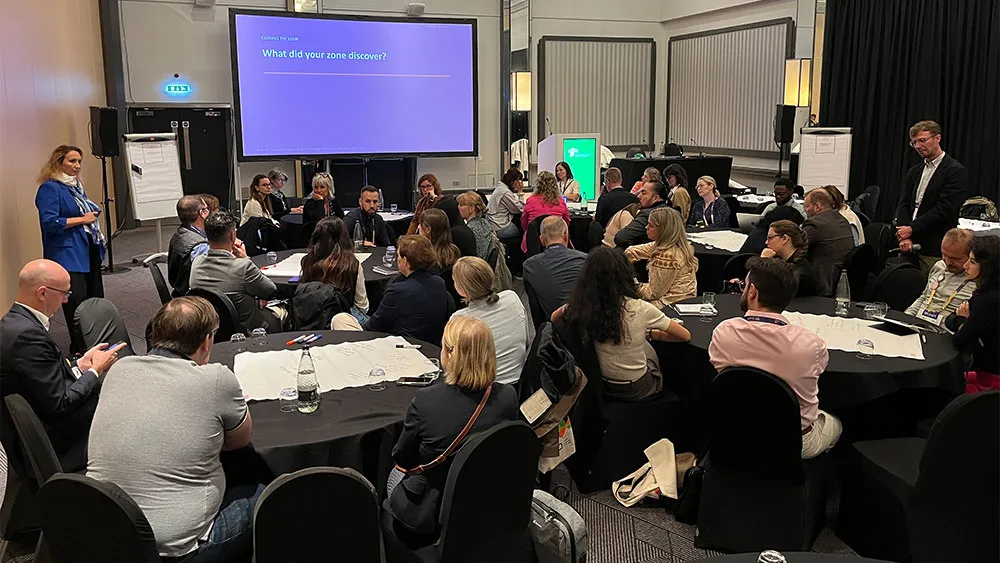
In his introduction to the session, Secretary General Kevin Guillaume shared insights from Circle U.'s experience of combining multiple funding sources, including EU, national and regional funding, while also mutualising resources through membership fees linked to the alliance's legal entity. He highlighted how this diversified approach can strengthen long-term financial sustainability and reduce dependence on individual funding programmes.
In the concluding part of the World Café session, participants summarised the main points from their group discussions. Key themes included diversifying funding sources beyond EU programmes, strengthening links to national and institutional funding, and ensuring that funding strategies align with each alliance's mission and priorities.
Participants also addressed questions of capacity and commitment, noting that securing funding is only the first step, while implementing and managing projects can place significant demands on both alliance offices and partner institutions. Other topics included institutional co-funding models, membership fees, fairness between partners, the risk of double funding, and the importance of strong support from university leadership.
A recurring theme was the need to embed alliance activities into the core operations of member universities, making participation part of everyday institutional work rather than an additional responsibility. Participants agreed that long-term sustainability depends not only on funding, but also on organisational commitment and integration across the alliance.
From supporting female innovators to understanding impact to exploring sustainable funding models, Circle U.’s contributions at EAIE highlighted different dimensions of the same challenge: how can European university alliances turn collaboration into lasting change? The discussions in Glasgow showed that achieving this requires space for new ideas, ways to learn from progress, and the institutional and financial foundations to sustain that work over time.