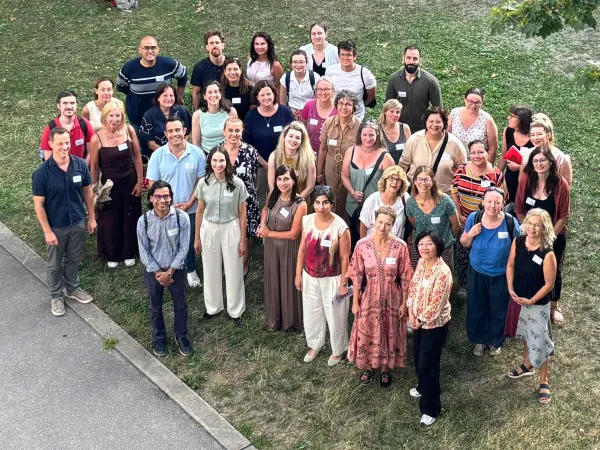
Language teachers, teacher educators and researchers from across the Circle U. alliance came together in Vienna for two days of exchange on language teaching and learning in higher education.
On 31 August and 1 September 2026, language teachers, teacher educators and researchers from eight Circle U. universities came together in Vienna for Language Teaching in Motion: Collaborative and Responsive Approaches. Organised by Armin Berger and Alexandra Schurz Vogelsang and supported by Circle U., the Centre for English Language Learning, Teaching and Teacher Education Research, and the English Language Competence team, the event formed part of the Circle U. Language Teachers’ Nexus (CU.LTN) initiative. Over two days, participants explored how research and communities of practice can respond to evolving learner needs and to the opportunities and challenges created by social, institutional and technological change.
The conference title provided a connecting theme for the two days. Language teaching is continually in motion, responding to increasingly diverse learners and changing academic and professional contexts. Yet change is rarely a straightforward journey from old to new. Language educators constantly negotiate tensions between tradition and innovation, technology and human interaction, global developments and local realities, and institutional demands and learner needs. The event created space to explore these tensions across different university contexts.
Exploring change in language education
Two keynote talks addressed questions at the heart of these developments in tertiary language education. Marije Michel, Professor of Second Language Acquisition at the University of Groningen, explored Second Language Writing in a Digital Age, considering L2 writing and the implications of digital tools and generative AI. Ursula Wingate, Professor of Language Education at King’s College London, focused on integrating academic literacy into disciplinary teaching and on the role of collaboration between subject lecturers and language specialists.
Beyond the keynote sessions, 25 presentations brought together research, classroom practice and critical reflection across a wide range of languages and higher education settings. Prominent themes included the changing role of digital technologies and AI; responsive and inclusive approaches to linguistic and cultural diversity; and connections between language learning and students’ academic, disciplinary and professional contexts. The programme also explored links between teaching, research and professional learning through topics such as assessment and feedback, pronunciation, materials development, language for specific purposes, teacher beliefs and research literacy.
Connecting ideas and building community
Alongside the formal programme, a teacher-wellbeing workshop led by Gabrielle Smith took participants outdoors, providing space to reflect on their work and recharge. A networking dinner offered further opportunities to continue conversations and get to know colleagues from other Circle U. universities.
The Vienna event strengthened connections within the CU.LTN community and created space for ideas to travel across languages, disciplines and universities. As conversations and collaborations continue across the alliance, Language Teaching in Motion asked not only how language education is changing, but what the Circle U. community might set in motion together.