Why this matters
Their work appears in the Proceedings of the National Academy of Sciences, known as PNAS. Founded in 1914, it is the journal of the US National Academy of Sciences and one of the most widely read and cited scientific journals in the world. It covers all fields of science, from biology and physics to chemistry and social science. Every article is reviewed by independent experts before it is accepted, and only research judged to be of outstanding quality and broad significance makes it in.
For Circle U., this publication is a mark of international recognition for research carried out within its community. The study was conducted by researchers from two of its member universities, Université Paris Cité and Aarhus University, in collaboration with partners from major research facilities and industry. It addresses a question of growing importance for medicine based on DNA and RNA.
DNA and RNA: using UV light to measure their structural diversity
For medicine based on DNA or RNA, chemical composition is only part of the story: the three-dimensional structure of these molecules can also influence their stability and biological activity. However, DNA and RNA can adopt a variety of structures, several of which may coexist in the same sample, making them difficult to distinguish and quantify.
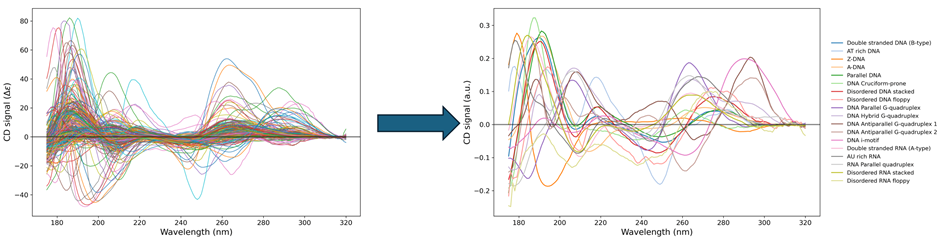
To address this challenge, Circle U. researchers from Université Paris Cité and Aarhus University have developed NA-CDQuant, a new UV-based method that estimates the relative proportions of different DNA and RNA structures within a sample. The method relies on circular dichroism spectroscopy, a technique that measures the difference in absorption of left- and right-circularly polarised UV light. This difference depends on the three-dimensional organisation of molecules and produces a characteristic spectral signature that provides information about their structure. However, when several structural forms are present in the same sample, their signals overlap, making individual contributions difficult to identify.
To overcome this limitation, the researchers analysed 225 DNA and RNA spectra, including measurements collected at the French SOLEIL and Danish ASTRID2 synchrotrons. They identified 18 reference signatures corresponding to different structural families and used them to develop NA-CDQuant, an algorithm capable of estimating the contribution of each structure to the overall measured spectrum.
By enabling a more detailed characterisation of DNA and RNA structural diversity, NA-CDQuant could provide a valuable tool for studying these molecules and support the development and quality control of DNA- and RNA-based medicines.
Read the full article: K. Mosca, S. V. Hoffmann, N. C. Jones, R. R. Sinden, F. Wien, S. Marco and V. Arluison, "NA-CDQuant: Quantitative spectral analysis of nucleic acid structure by circular dichroism spectroscopy", PNAS, 123(41), 2026. https://doi.org/10.1073/pnas.2617882123
A collaboration between: Université Paris Cité, Aarhus University (Denmark), CEA, Synchrotron SOLEIL, Sanofi and the South Dakota School of Mines and Technology (United States).
Looking to connect?
Véronique Arluison Veronique.Arluison@u-pariscite.fr (Université Paris Cité UFR SDV)
Søren Vrønning Hoffmann vronning@phys.au.dk (Aarhus University, Department of Physics and Astronomy, Centre for Storage Ring Facilities (ISA)
Explore the work of Circle U. researchers in our Research outputs repository and find the right expert in our Academic Directory, linked to your ORCID profile.