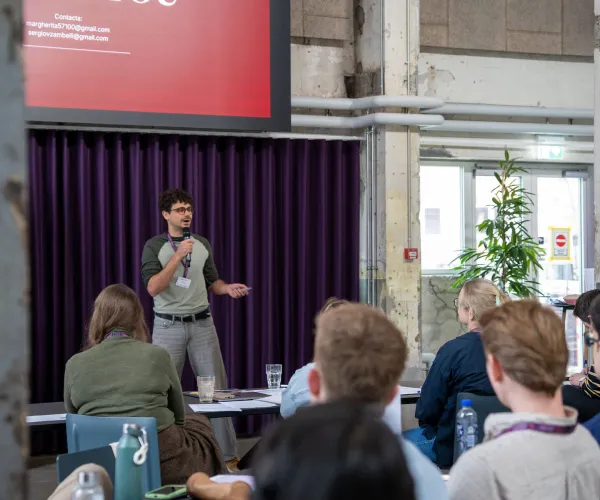
For one week, 20 to 30 student entrepreneurs and project representatives from across Circle U. will come together at UCLouvain to prototype, test and learn from each other. The week is hosted by OpenHub, UCLouvain’s space for prototyping and innovation, and its coaches will work alongside the teams from start to finish.
This edition is built around real-world experimentation. Each team will pick one critical assumption about its project, turn it into something users can actually try, put it in front of real users or customers, and decide what to improve next.
A prototype doesn’t have to be a finished product. Depending on your question, it could be a mock-up, an interactive demo, a landing page, a video, a role-play or a manually operated service.
The Cross-InCU.bation Week is an initiative of the Circle U. InCU.bator.
Learning outcomes
Each project will leave the week with:
- a sharper problem statement, a clearly defined target user or customer, and a prioritised assumption to test;
- one purposeful prototype or entrepreneurial artefact built to test that assumption;
- evidence from at least one meaningful real-world interaction or experiment;
- a documented decision to continue, iterate or pivot, based on what the team has learned;
- a short pitch and a practical next-steps plan, explaining which uncertainties (technical, market) have been reduced and what remains unproven.
Programme
On February 19th, from 9:00-13:00, each team reviews where its solution stands, sets out a work plan for the week and pitches its project.
Morning: Team building and icebreakers
Afternoon: Beerstorming for project centering
Evening: Cultural event
Morning: Testing objectives and assessment
Afternoon: Tools presentation (XYZ hypothesis, Prototyping Compass, user design and more)
Evening: Cultural event
Morning: Track-based prototyping workshops and UX design approach
Afternoon: Track-based prototyping workshops
Evening: Track-based prototyping workshops
Morning: Track-based prototyping workshops
Afternoon: Real-world deployment and testing
Evening: Real-world deployment and testing
Morning: Track-based prototyping workshops
Afternoon: Final presentations in front of a jury, followed by a closing ceremony
Team & contact
Academic lead: Benoît Macq, Academic Chair of the InCU.bator, UCLouvain
Associate professors:
- Merethe Kruse, Academic Coordinator of the InCU.bator, Aarhus University
- Alessio Cavicchi, Academic Chair of the InCU.bator, University of Pisa
- Marco Masia, Academic Chair of the InCU.bator, University of Vienna
The week is organised by the OpenHub team at UCLouvain: Régis Lomba, Mathias Marques, Corentin Warzée, Nicolas Bioul, Pâcome Lerouge de Rusunan and Mickael Turkoglu.
If you have any questions about the programme or the application process, please email Nicolas Bioul at nicolas.bioul@uclouvain.be, using “Cross Incubation Week 2027” as the subject line.
Why take part?
-
Test your project with real users or customers, with coaches by your side.
-
Get hands-on access to OpenHub’s prototyping facilities, methods and expertise.
-
Reduce technical and market uncertainty, and leave with a clear decision on what to do next.
-
Learn from experienced entrepreneurs and alumni.
-
Meet student entrepreneurs from across Europe and learn from their projects.
Who can apply?
The call is for student-led, early-stage entrepreneurial projects linked to a Circle U. university that have moved beyond an untested idea but still need to validate, design or improve their user experience. Individual founders and small teams are both welcome.
You should have:
- a reasonably well-defined problem, a proposed solution and an initial target user or customer segment;
- some evidence of early discovery or market validation (user interviews, observations, a small survey backed by qualitative insights, conversations with potential clients, or a first landing-page or service test);
- a concept that can be represented and tested during the week. A sketch, a storyboard, a mock-up or an earlier Turkish Automaton experiment is enough;
- a clear, short-term question to investigate, and a willingness to adapt your concept in the light of what you find;
- availability to take part fully throughout the week and to engage with external users or organisations.
More advanced projects are welcome too, as long as they still have a significant user, value-proposition or adoption assumption to test.
The programme is less suited to projects at a purely speculative stage, with no identified users and no discovery work, or to established ventures looking mainly for investment or scaling support rather than experimentation.
How to apply?
Your application should include:
- your CV;
- a one- to two-page executive summary covering the problem, target audience, solution, current evidence and your most pressing near-term challenge;
- a short progress statement: what you have tested, what is still uncertain, and what you hope to achieve during the week.
A slide deck, sketches or prototype links are optional.
The team look at readiness for your project’s stage, not at how polished your pitch deck is.
Agenda:
- Applications open: 20 November
- Applications close: 5 December
- Interviews: 11–18 December
- Selection and notification: by 21 December
Funding
As this course is organised as a blended course within the Erasmus+ framework, participants may apply for a grant through their home university, in accordance with their institution’s rules.
Please contact the Circle U. office at your home university:
- Aarhus University: aarhus@circle-u.eu
- University of Belgrade: Nikola Savić – nikola.savic@rect.bg.ac.rs
- Humboldt-Universität zu Berlin: circle-u.mobility@hu-berlin.de
- King’s College London: circle-u@kcl.ac.uk (Erasmus+ funding not available; internal funding may apply)
- UCLouvain: infocircleu@uclouvain.be
- University of Oslo: oslo@circle-u.eu
- Université Paris Cité: circleu.iro@u-paris.fr
- University of Pisa: circleU.erasmus@unipi.it
- University of Vienna: circle-u@univie.ac.at"