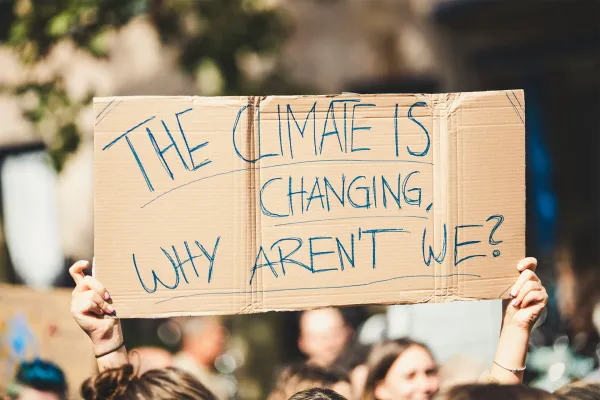
Why is it that we know so much about climate change and other environmental sustainability challenges, but it is still so hard to do something about them? What does it take for leaders to listen to scientific knowledge - or to ignore it - when decisions are made in politics or industry? And how can different forms of knowledge be translated into political action for a more sustainable world?
In this course, you will examine the role of knowledge in efforts to achieve a more sustainable future. The course shows how our understanding of issues such as climate change and biodiversity loss is shaped by specific types of knowledge, which in turn affects how they are acted on politically. You will be introduced to theoretical perspectives on the role of science in society and use these perspectives to analyse real-world topics. You will learn to identify how scientific knowledge can contribute to - and help to manage - controversies related to environmental sustainability, and reflect on how your own disciplinary training can contribute to addressing such controversies.
The course is offered as a synchronous online course and is available to students at all Circle U universities. Through collaborative analysis and presentations, you will gain practical experience with working across disciplinary boundaries as well as national borders. Mandatory coursework includes online meetings, individual preparations and collaborative exercises.
Learning outcomes
- An understanding of how different forms of knowledge have shaped societal responses to environmental sustainability
- An overview of key theoretical approaches to understanding the role of scientific knowledge in society
- Identifying how different forms of knowledge are involved in controversial environmental issues
- Practical experience with interdisciplinary collaboration and with presenting your disciplinary competence to others
- Understanding how various forms of expertise are used in decision-making in public and private institutions
- Ability to reflect on the role of your own disciplinary training in achieving sustainability
Recommended previous knowledge
It is recommended that you have completed at least 60 ECTS of previous studies prior to enrolling in this course.
Teaching
The course will be taught through online seminars in April and May 2027.
- Monday 19 April, 10:15-12:00
- Thursday 22 April, 10:15-12:00
- Monday 26 April, 10:15-12:00
- Thursday 29 April, 10:15-12:00
- Monday 3 May, 10:15-12:00
- Monday 10 May, 10:15-12:00
- Thursday 13 May, 10:15-12:00
The completion of online assignments and participation in online seminars is mandatory throughout the course.
Examination
The final assessment is done on the basis of a collaborative presentation in audio or video format, which is to be submitted online together with a short, individual reflection note.
Dates for the home exam will be announced soon.
Grading scale
Grades are awarded on an A-F scale.
Contact
Course-related questions:
- Course coordinator: Petter Brønstad, petter.bronstad@tik.uio.no
- Course leader: Bård Lahn, University of Oslo
For questions related to, for example, ECTS recognition, please contact the Circle U. office at your home university:
-
Aarhus University: aarhus@circle-u.eu
-
University of Belgrade: Nikola Savić – nikola.savic@rect.bg.ac.rs
-
Humboldt-Universität zu Berlin: circle-u.mobility@hu-berlin.de
-
King’s College London: circle-u@kcl.ac.uk
-
UCLouvain: infocircleu@uclouvain.be
-
Université Paris Cité: circleu.iro@u-pariscite.fr and on our website
-
University of Pisa: circleU.erasmus@unipi.it
-
University of Vienna: circleu-mobility@univie.ac.at
Partners
This course is hosted by TIK Centre for Technology, Innovation and Culture at the University of Oslo in collaboration with the Department of Science and Technology Studies at the University of Vienna.